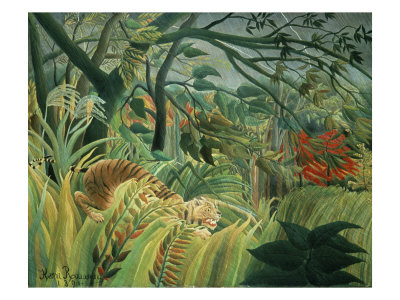
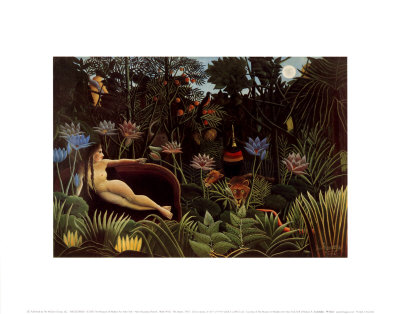
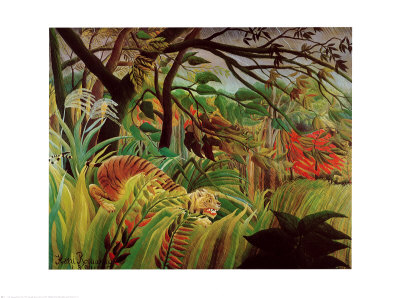
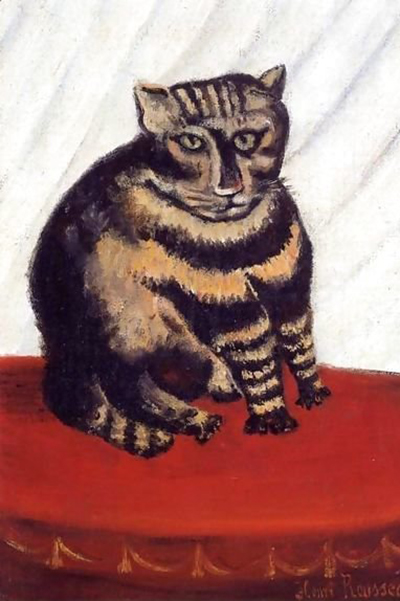
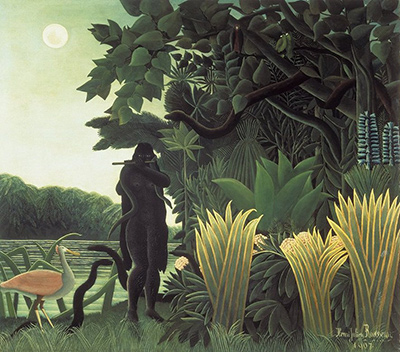
Henri Rousseau's waterfall jungle scenes represent a unique convergence of chaotic vegetation and serene hydrological forces, creating a visual paradox that has captivated audiences for over a century. While best known for his dense forests, his depictions of falling waters reveal a masterful ability to balance the weight of the jungle with the fluidity of the stream. These compositions are not merely records of a place, but constructed visions where the physics of water are harmonized with the impossible density of an imagined paradise.
The Composition of Verticality
In Rousseau's waterfall paintings, the artist frequently utilizes a strong vertical axis to draw the viewer's eye upward. Unlike many contemporary artists of the late 19th century who favored horizontal compositions to suggest vast plains, Rousseau often stacked elements to create a sense of towering height and enclosed space. The waterfall becomes the central pillar of the composition, a white ribbon of motion that cuts through the static, heavy masses of green foliage.
The specific structural elements of these scenes typically include:
- A dominant central waterfall that acts as the focal point.
- Layers of foliage that appear to grow directly from the rocks.
- Grey, monochromatic tones used for the rocks to contrast with the greens.
- A sense of enclosure that makes the viewer feel surrounded by nature.
- A clear visual path provided by the water through the labyrinth of trees.
This verticality serves to emphasize the immensity of the jungle, making the trees seem to grow directly out of the rocks and framing the water as the only clear path through the dense undergrowth. The rocks themselves are often rendered with a grey, almost monochromatic tone, which acts as a foil to the vibrant greens and blues of the surrounding vegetation, ensuring that the white water stands out with startling clarity against the dark background.
A Study in Color and Light
The color palette in these waterfall scenes is as distinctive as the composition itself. Rousseau did not attempt to replicate the harsh, direct sunlight of a real tropical day; instead, he filtered the light, creating a hazy, atmospheric quality that suggests a mist hovering around the cascade. The water is rarely depicted as a transparent, sparkling river but rather as a solid, ethereal substance. He often used shades of pale blue and white, sometimes tinged with grey, to indicate the foam and the spray.
This lack of intense, blinding highlights gives the water a soft, dreamlike texture, transforming a potentially violent natural event into something tranquil and almost musical. The surrounding leaves are painted in varying intensities of green, from the dark, shadowed emerald of the deep undergrowth to the bright, almost yellow-green of leaves catching the light near the top of the falls. This manipulation of light and color creates a unified visual rhythm where the movement of the water seems to harmonize with the stillness of the plants, creating a sense of suspended time.
The Technique of the Naive Brushstroke
What defines these works as quintessential examples of naive art is the specific technique Rousseau employed. His brushstrokes are visible, deliberate, and often appear to be applied with a heavy hand, yet they possess a remarkable internal logic. He did not strive for photorealistic detail; instead, he focused on the general impression and the emotional resonance of the scene. The leaves are often depicted with thick, impasto strokes that add texture and depth, while the water flows in smooth, sweeping lines that contrast with the jagged edges of the rocks.
This juxtaposition of rough, textured foliage against the fluid lines of the stream creates a dynamic tension on the canvas. It is this unrefined yet confident application of paint that separates his work from the academic realism of his peers, capturing the essence of a place that exists only in the mind of the artist. By prioritizing the feeling of the scene over the literal accuracy of the landscape, Rousseau achieved a level of emotional truth that mimics the raw power of nature.
The Atmosphere of Solitude
Despite the dense canopy and the height of the waterfall, there is a profound sense of solitude in these paintings. Rousseau rarely included figures of people or animals to scale the scene, allowing the viewer to feel like a silent observer in a world untouched by human presence. The absence of human activity adds a layer of mystery and permanence to the landscape. The waterfall flows forever, and the jungle stands watch, indifferent to the passing of time.
This isolation is not portrayed as lonely or bleak, but rather as peaceful and self-contained. The viewer is invited to step into this private realm, to listen to the sound of the water and feel the humidity of the air, experiencing a moment of quiet communion with nature that feels both ancient and immediate. The lack of human figures removes the barrier between the observer and the observed, placing the viewer directly within the heart of the jungle.
Why These Scenes Remain Enduring
The enduring appeal of Rousseau's waterfall jungle scenes lies in their ability to evoke a specific kind of fantasy. They are not accurate geological records but rather emotional landscapes that speak to a desire for escape and wonder. By simplifying complex natural forms and exaggerating their colors and shapes, Rousseau created a visual language that resonates with anyone who has felt the pull of the unknown. Whether viewed in a museum gallery or a book collection, these paintings continue to transport the observer to a world where the boundaries between reality and imagination are blurred. The work remains a testament to the power of naive art to capture the soul of nature through the unfiltered eye of an artist, offering a sanctuary that feels both lost and found all at once.