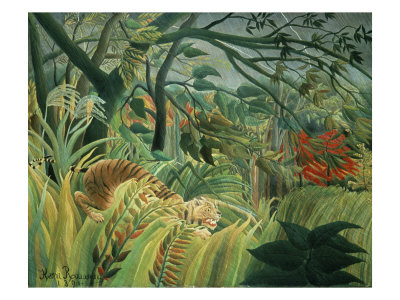
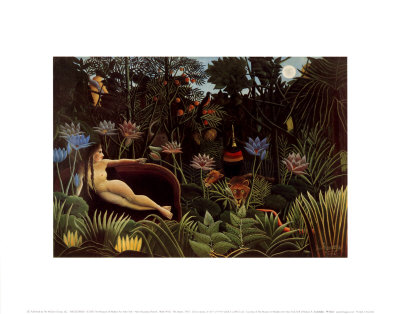
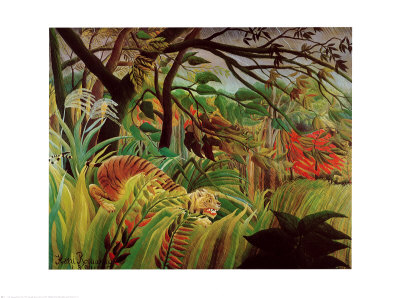
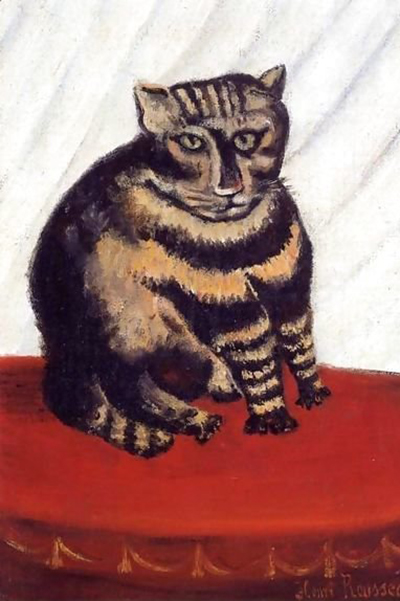
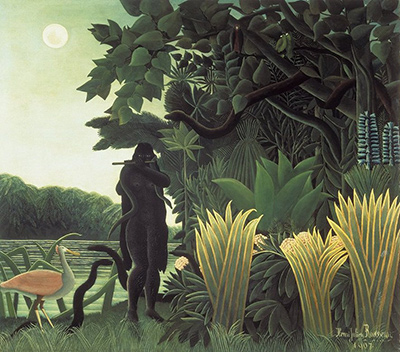
To emulate the vision of Henri Rousseau, one must first abandon the pursuit of photorealistic perfection in favor of capturing the overwhelming, almost hallucinatory presence of spring. His work teaches us that the true magic of a garden does not lie in the exact number of petals on a single rose, but in the chaotic, vibrant energy that seems to burst forth from the canvas itself. By focusing on the interplay of light, texture, and bold, flat planes of color, you can create a painting that feels less like a record of nature and more like a memory of a dream.
The Architecture of Imagination
Rousseau did not simply paint what he saw with his eyes; he painted what his mind constructed when he closed them. When approaching a spring subject, do not attempt to render every leaf and branch with precise botanical accuracy. Instead, focus on the overall shape and rhythm of the composition. Imagine the garden not as a chaotic mess, but as a structured landscape where flowers act as focal points against a vast, negative space. This sense of scale is crucial; the flowers often appear to float above the ground, detached from the soil, creating a surreal distance between the viewer and the bloom.
You must simplify your forms. A cluster of cherry blossoms should not be a detailed study of individual blooms but a unified mass of pink and white, perhaps with a few strategically placed dark leaves to create contrast. The background should often be simplified into blocks of blue sky or soft, hazy greens, allowing the foreground elements to dominate the visual field. This technique creates that distinct "jungle" feeling in his work, where the boundary between the earth and the sky dissolves, and the flora seems to exist in its own unique, suspended universe.
Mastering the Flat Light
One of the most defining characteristics of the Naive style is the handling of light. Rousseau rarely used the soft, diffused lighting associated with Impressionism. Instead, he utilized hard, direct light that casts sharp, defined shadows and creates a high contrast between illuminated areas and dark undercurrents. When painting spring blossoms, think of the sun as a physical force hitting the canvas directly, rather than filtering through an atmosphere.
To achieve this, you should avoid blending colors too smoothly. Keep the edges of your brushstrokes distinct and visible. The light hitting a petal should be a bright, pure color, while the shadow cast by that same petal should be a deep, unblended dark. This contrast gives the painting a sense of vibrancy and energy. Do not shy away from using white or off-white as a primary color to represent the sunlit parts of the flowers, as this mimics the intensity of a bright spring day. The interplay of these stark contrasts is what makes the scene feel alive and breathing, much like the gardens Rousseau depicted in his dreamlike state.
The Secret of the Texture
The texture of the paint is another vital element in capturing the spirit of Rousseau's work. His brushwork was loose, gestural, and often seemed to apply paint thickly, almost in a way that suggested the artist was working quickly and with great enthusiasm. When applying your paint, do not smooth it out too much. Leave the texture of the brushstroke visible, especially in the areas representing the petals and the leaves.
Think of the paint as a physical substance on the canvas. Use a palette knife to create some of those thick, impasto areas, or use a brush with a stiff bristle to dab the paint on. This adds a tactile quality to the painting that invites the viewer to reach out and touch the surface. The roughness of the texture contrasts beautifully with the smooth, soft shapes of the flowers, creating a dynamic visual experience. It is this combination of rough texture and soft form that gives the painting its unique, dreamlike quality.
Tools of the Seasonal Dreamer
To execute this style effectively, you will need a specific set of tools and a willingness to experiment with color. The palette should be limited but intense. Think of bright, saturated colors: electric blues, vivid greens, and pure pinks and yellows. Do not worry about color mixing; let the colors speak for themselves. Your palette knife, stiff brushes, and a flat surface are your best friends in this endeavor.
Here is a practical list of recommendations for setting up your spring canvas session:
- Use a heavy, textured canvas to provide a surface that can hold thick layers of paint without sagging.
- Choose a palette with a range of bright, pure colors, avoiding pre-mixed pastels to maintain the intensity of the bloom.
- Prepare a variety of stiff brushes and at least one large palette knife for creating texture.
- Ensure your workspace is well-lit, ideally with natural light, to help you judge the true saturation of your colors.
- Keep your mind open to abstraction; if a detail feels too realistic, simplify it immediately to maintain the dreamlike quality.
The Final Whisper of Spring
Once your composition is complete and the light has settled into the shadows you have created, step back and let the painting breathe. A painting in the Rousseau style is not finished until it possesses a certain kind of silence. It is a quiet place where the chaos of nature has been tamed into a beautiful, orderly arrangement. The viewer should feel a sense of awe and perhaps a little confusion, as the world presented on the canvas feels both familiar and entirely new.
Remember that the goal is not to replicate the spring outside your window, but to capture the feeling of spring as it exists in your imagination. The blossoms are not just flowers; they are symbols of renewal, hope, and the boundless energy of life. By embracing the flat planes of color, the hard light, and the textured brushwork, you invite the viewer into a world that is both grounded in reality and lifted high into the realm of dreams. This is the true essence of the Rousseau style, and it is a gift that can be given to the world through the simple act of painting.