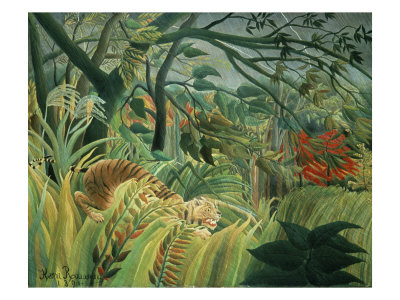
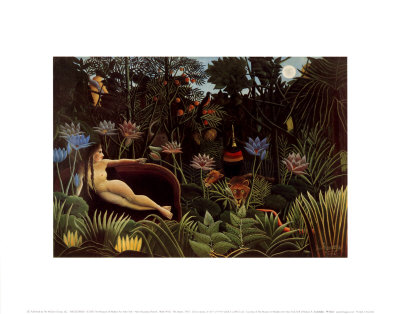
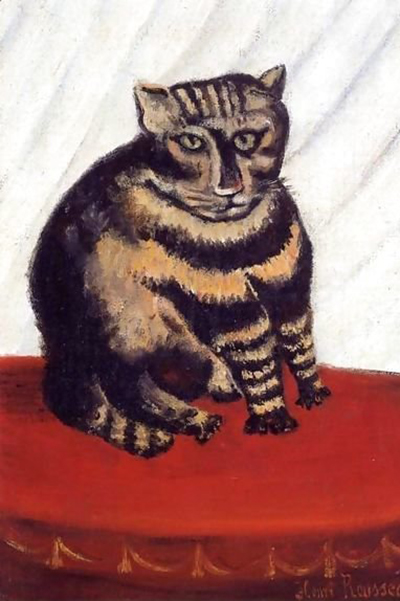
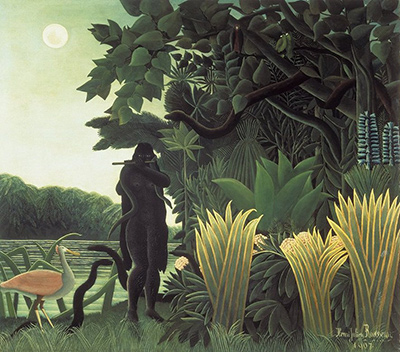
Henri Rousseau's enduring legacy rests not merely on his technical naivety or his unique brushwork, but on the profound, almost photographic way he reconstructed reality through the filter of memory. He did not simply copy what he saw; he curated what he remembered, weaving together fragmented impressions of forests, gardens, and mysterious nocturnal scenes into cohesive, dreamlike narratives that feel both immediate and timeless.
The Architecture of the Forest
The dense, towering trees that dominate so many of Rousseau's masterpieces are not literal transcriptions of a specific location. Instead, they represent a collective memory of the deep woods surrounding his home in Fontainebleau, filtered through the imagination of a man who spent his final years confined to a prison cell. His mind filled in the gaps where his eyes could not reach.
- Layered Depth: Rousseau often used overlapping shapes and jagged silhouettes to create a sense of immense depth, mimicking the way human memory compresses distant objects into distinct, looming forms.
- Light and Shadow: He retained the memory of the dappled sunlight filtering through leaves, but he exaggerated the contrasts to create a mysterious, almost supernatural atmosphere that feels more like a recollection of a specific afternoon than a literal record of the time.
The Logic of Nature in the Artist's Mind
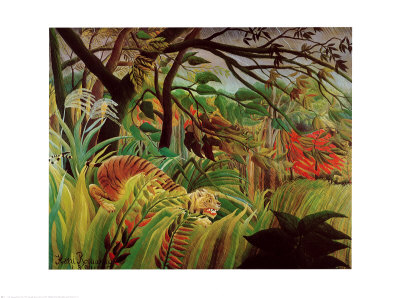
While the forest provides the setting, the creatures that inhabit it are products of Rousseau's associative memory. The jaguar, the panther, and the deer in his paintings often appear in moments of stillness or surprise, reflecting a memory of the wild animals he observed in the zoo or the park, rather than the chaotic motion of the wild.
The Psychology of the Zoo
The animals in Rousseau's work are frequently derived from his memories of the Jardin des Plantes in Paris, where he spent significant time observing wildlife.
- Static Grace: Unlike real animals in motion, Rousseau's creatures often appear frozen in a moment of repose or sudden alertness, a result of how memory selectively freezes dynamic movement into a single, perfect frame.
- Symbiotic Coexistence: He constructed scenes where humans and animals interact with a sense of familiarity and ease, a memory of a romanticized encounter that never actually took place in the way he depicted it.
The Role of the Night in Recollection
Night scenes, particularly those featuring the "Night Watch" or moonlit paths, are among the most famous and enigmatic aspects of his oeuvre. These compositions rely heavily on the artist's ability to recall the emotional tone of the night rather than the precise topography of a street or path. The moon is often a disembodied orb, a memory of the light itself rather than a reflection of a specific celestial body in a specific sky. The dark background serves as a void that allows the remembered details to stand out with hyper-clarity, much like how the brain highlights important information during sleep or deep recollection.
The Technique of Reconstruction
Rousseau's method was not that of a snapshot photographer, but that of a painter reconstructing a scene from the fragments of his own mind. He would look at a subject, close his eyes, and allow the sensory details to play out in his imagination before opening them again to paint. This process ensured that every element in his canvas—from the texture of the leaves to the expression of the hunter—carried the weight of personal experience.
The result is a body of work that feels universally relatable because it taps into the universal human experience of memory: the way we remember places not as they were, but as they felt, with colors heightened, shadows deepened, and emotions amplified. His paintings are not documents of reality, but monuments to the power of the mind to reshape the world. By understanding the role of memory in his construction, we see that Rousseau was not simply a naive painter, but a master storyteller who used the canvas as a vessel for his internal history. The trees, the beasts, and the moon are all there because they were there in his mind, waiting to be liberated onto the surface, creating a visual poetry that continues to captivate audiences centuries after his death.