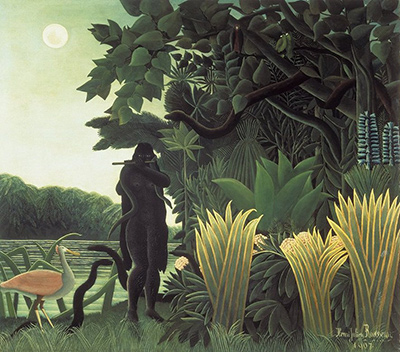
Henri Rousseau's vibrant canvases often depict lush jungles and mysterious nightscapes, yet few observers stop to consider the profound psychological drive that led him to obsessively paint exotic animals. His work does not merely depict wildlife; it reveals a fractured mind seeking comfort in the distant, untamed world while retreating from the rigid realities of the human society surrounding him. To understand Rousseau, one must look past the tropical settings and into the quiet, anxious psyche of a man who found his true freedom only within the confines of his own studio.
The Banality of the Everyday
Living in the heart of Paris during the Second Empire, Rousseau was surrounded by a world that felt increasingly suffocating. The grand boulevards, the polite society, and the strict artistic academies offered little room for the raw, unfiltered emotions he felt. For a man who was often described as eccentric and socially awkward, the city became a maze of judgment and expectation. Instead of finding inspiration in the bustling streets where people walked and talked, Rousseau turned his gaze outward, toward the colonies he had visited only briefly in his youth. He sought a world that was not governed by the rules of manners or the constraints of reason. The exotic became a sanctuary, a place where he could exist without the burden of being a normal person. In his paintings, the animals often appear in impossible spaces, disconnected from their natural habitats, which mirrors his own internal state of feeling isolated yet strangely safe in his own solitude.
The Fear of the Unknown
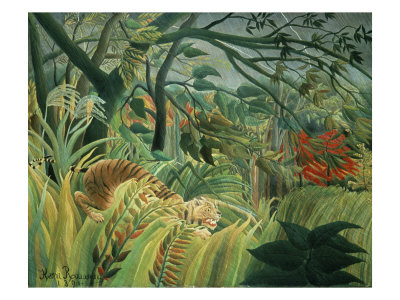
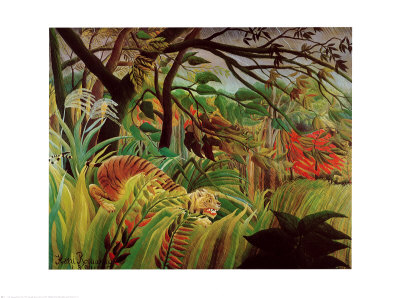
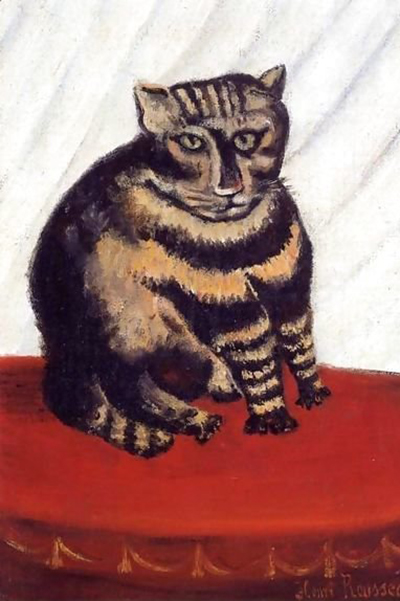
There is a specific tension in Rousseau's animal studies that goes beyond simple fascination; it is a deep-seated anxiety about the unknown. While he painted lions, jaguars, and monkeys, these creatures are often rendered with a stiffness that suggests they are being observed from a distance, perhaps through a window or a glass case. This perspective reflects his fear of losing control. The animals in his work are not wild and free in the way one might imagine; they are contained, framed, and often staring directly at the viewer with an intensity that feels almost threatening. This gaze is a projection of his own inner turmoil. He was terrified of the chaos of nature, yet he needed to express it. By freezing these animals in a moment of stillness, he was trying to tame the very things that unsettled him most. The juxtaposition of the delicate, almost fragile brushwork with the massive, looming forms of the beasts creates a visual dialogue between the artist's delicate soul and the overwhelming power of the natural world.
The Unconscious Language of Form
To truly grasp the psychology behind his obsession, we must look at how Rousseau constructed the forms of his animals. He did not simply copy what he saw; he interpreted what he felt. The limbs of his leopards and the tails of his monkeys often twist in ways that defy anatomical logic, creating a sense of movement that is more about the flow of his imagination than biological accuracy. This distortion is a hallmark of his subconscious mind speaking through his hands. When the artist is overwhelmed by emotion, the hand moves faster than the mind can organize it, resulting in shapes that carry emotional weight rather than structural precision. In his paintings, the animals often seem to be part of a larger, invisible ecosystem that the viewer cannot see but can feel. The space around them is filled with an energy that is electric and volatile. The animals are not just subjects; they are avatars for his own repressed desires and fears. They are the voices of his inner self, shouting in a language that the conscious mind refuses to understand.
A Retreating Island
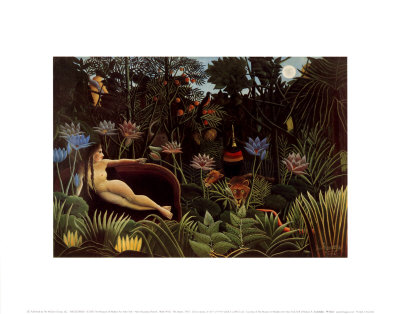
The recurring theme of Rousseau's work is the idea of retreat. Whether it is the dense jungle, the moonlit forest, or the mysterious corner of his studio, he builds walls around his art. The animals are the inhabitants of these walls, safe behind glass or in the shadow of ancient trees. This isolation is crucial to understanding his psychology. He was a man who retreated from the world to find himself. By focusing on animals, he was engaging in a form of escapism that allowed him to process his trauma, his loneliness, and his creative blocks. The exotic animals served as a buffer, a layer of protection between him and the harsh realities of human interaction. In a way, painting them was an act of survival, allowing him to navigate the complex landscape of his own mind without getting lost.
Key Psychological Drivers
Several distinct factors fueled Rousseau's unique approach to depicting fauna, acting as the engine behind his prolific output of animal studies. These drivers were not random but formed a cohesive system of defense and exploration within his art.
- The need to distance himself from the judgmental eyes of Parisian society by focusing on creatures that could never understand him.
- A desire to control the uncontrollable by freezing dynamic animals into rigid, manageable compositions.
- The use of animals as symbolic avatars for his own hidden, repressed emotions and desires.
- The creation of a private sanctuary where he could exist without the constraints of social etiquette.
- The fear of the natural chaos surrounding him, counteracted by the artificial order of his studio and canvas.
- The exploration of the unconscious mind through distorted forms that prioritized emotional truth over anatomical accuracy.
- The belief that the exotic world offered a truer representation of the human soul than the mundane daily routine.
The Enduring Mystery
Ultimately, the psychology behind Rousseau's obsession with exotic animals is a story of a man who loved the wild but was afraid of it. He loved the freedom they represented but feared the unpredictability of their movements. In his art, he attempted to reconcile these two opposing forces. The animals remain a symbol of the untamed spirit that lived within him, a spirit that could not be contained by the academic rules of the day. They are the ghosts of his youth, the echoes of his dreams, and the silent witnesses to his long, quiet life. By studying these creatures, we do not just see a painter's interest in fauna; we see a soul searching for a way to be free, even if that freedom exists only on a canvas. The magic of Rousseau lies not in the accuracy of his drawings, but in the truth of his feeling, a truth that resonates deeply with anyone who has ever felt out of place in a world that did not understand them.
Related reading
- The Digital Brush: Reimagining the Dream World of Rousseau
- The Child in the Jungle: Cultivating the Spirit of Naïve Art
- Finding Your Own Wild Garden: A Guide to Choosing Subjects in Naïve Art
- The Artist's Canvas: Unveiling the Essentials of Naïve Creation
- Unlocking the Surreal Garden: A Guide to Finding Historical Naïve Art for Inspiration