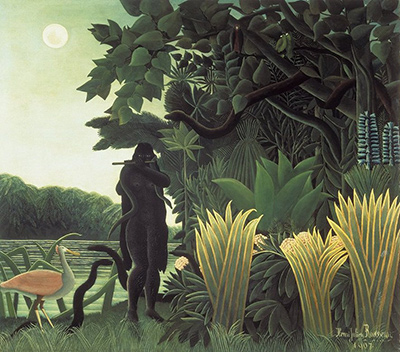
Henri Rousseau stands as a solitary beacon in the vast gallery of art history, a man who painted without leaving his room yet somehow managed to conjure entire worlds. His work serves as a crucial bridge between the rigid academic traditions of the 19th century and the raw, untutored energy of modern naive art, proving that the most profound visions often come from the quietest minds.
The Unconventional Path to Paris
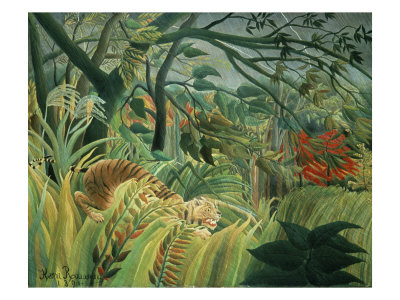
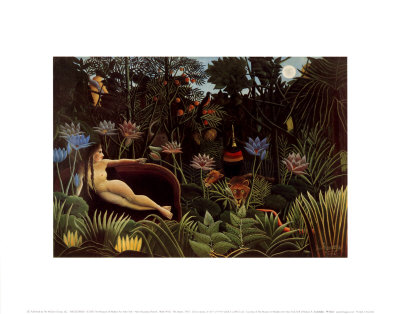
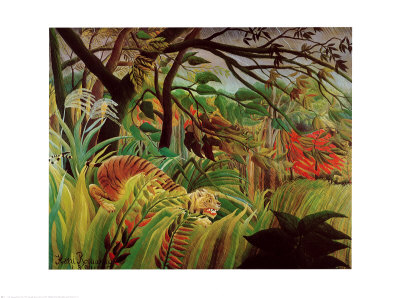
Born in Paris to a wealthy family, Rousseau possessed an innate talent for drawing that flourished throughout his childhood. Unlike his contemporaries who traveled to exotic locations to study nature, Rousseau created his famous jungle scenes entirely from his imagination, aided by detailed studies of plants in the Jardin des Plantes and sketches of African birds brought back by travelers. This separation between the artist and the subject became a defining characteristic of his work. He did not seek to replicate the visual accuracy of the real world but rather to capture the emotional and atmospheric essence of a dreamlike environment. His style evolved from early, loose watercolors to complex, highly detailed oil paintings filled with bold, flat colors and intricate patterns that defied traditional perspective rules.
The Surreal Vision of the Wild
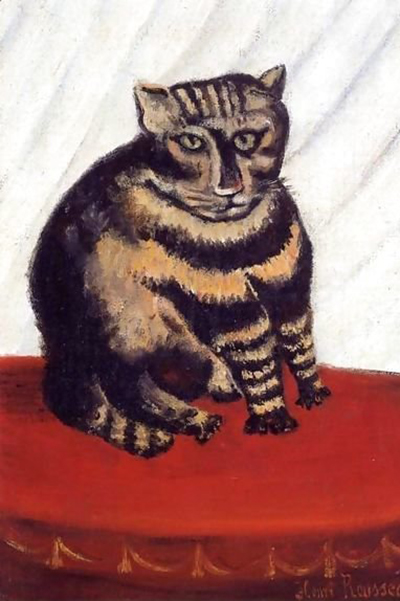
At the heart of Rousseau's work lies a profound sense of solitude and introspection, even as he painted bustling ecosystems teeming with life. His figures are often small and isolated within vast expanses of foliage, suggesting a human condition that feels both insignificant and profoundly connected to nature. The animals in his paintings possess an almost supernatural presence, rendered with a clarity that contrasts sharply with the dense, layered backgrounds. This juxtaposition created a visual tension that was revolutionary for his time. He was not merely depicting animals; he was constructing mythological landscapes where the boundaries between the familiar and the unknown blurred seamlessly. Critics were often baffled by his technique, noting the lack of foreshortening and the flatness of his forms, yet these very qualities became the hallmarks of a new artistic language.
The Legacy of the Untrained Hand
While Rousseau was actually a highly trained academic artist, he deliberately chose to bypass the conventions of formal instruction in favor of his own internal logic. This paradox became the cornerstone of his influence on the movements that followed. By rejecting the complexities of academic realism, he paved the way for a philosophy of art that values intuition over technique. His approach inspired a generation of artists who sought to capture the purity of vision found in children or rural peasants. Today, his work serves as a practical manual for understanding how to break free from the shackles of literal representation.
- Rousseau's work anticipated the emergence of Art Brut by emphasizing raw, unfiltered expression over polished technique.
- He demonstrated that perspective and anatomical correctness were not prerequisites for creating a powerful visual narrative.
- His use of bold outlines and vibrant palettes became a standard toolkit for subsequent naive and primitive art movements.
- The concept of the "dream jungle" provided a template for artists to explore subjective reality rather than objective observation.
- His life story itself became a narrative device, inspiring others to embrace their own eccentricities as sources of creative strength.
A Life of Perplexity and Legacy
Throughout his life, Rousseau lived with a reputation that oscillated between admiration for his unique vision and confusion regarding his techniques. He was known to be somewhat eccentric, often speaking in riddles and displaying a deep love for gardening and collecting exotic specimens. Despite his personal quirks, he achieved significant success during his lifetime, receiving commissions from prominent figures and exhibiting widely. However, his posthumous fame grew even more spectacular, solidifying his status as a master of the impossible. Today, his works are celebrated not just for their aesthetic beauty but for their psychological depth. They continue to inspire artists and viewers alike, proving that the most profound images often come from the quietest minds.
The Enduring Appeal of His Work
In conclusion, Henri Rousseau's journey from a shy country boy to a global icon of naive art is a testament to the power of individual expression. His unique perspective challenges us to look beyond surface appearances and consider the hidden worlds within our own perceptions. Whether you are an aspiring artist seeking to break free from traditional constraints or a collector interested in the nuances of modern art history, Rousseau offers a compelling narrative. His jungle is not just a collection of trees and birds; it is a mirror reflecting the dreams of humanity, urging us to explore the spaces that lie just beyond the edge of our waking world. Through his enduring influence, we learn that true artistry lies in the courage to imagine a reality that no one has ever seen before.
Related reading
- The Digital Brush: Reimagining the Dream World of Rousseau
- The Child in the Jungle: Cultivating the Spirit of Naïve Art
- Finding Your Own Wild Garden: A Guide to Choosing Subjects in Naïve Art
- The Artist's Canvas: Unveiling the Essentials of Naïve Creation
- Unlocking the Surreal Garden: A Guide to Finding Historical Naïve Art for Inspiration