Henri Rousseau, the enigmatic French painter often hailed as a master of the naive style, spent four decades painting landscapes that seemed plucked directly from the subconscious mind. His journey from a timid clerk in the railway station to the celebrated "Sleeping Gypsy" and the mysterious "The Red Barn" reveals a profound transformation in how he captured the magic of nature. This article explores the specific visual shifts that occurred throughout his career, offering a practical look at how his unique perspective evolved over time.
The Early Years: Impressionism and the Railway Station
In the first two decades of his life, Rousseau's work was heavily influenced by the dominant art movements of his era, particularly Impressionism. During this period, he traveled frequently to Paris, where he immersed himself in the studios of artists like Claude Monet and Pierre Bonnard. His early sketches were characterized by a certain hesitation and a reliance on the established techniques of his contemporaries. He utilized loose brushstrokes to capture the fleeting effects of light and color in the French countryside, though his subjects were often mundane scenes of everyday life rather than fantastical jungles.
During these formative years, his compositions tended to be more integrated and realistic, reflecting a desire to learn the rules of perspective and anatomy before breaking them. He painted still lifes with meticulous attention to detail, ensuring that the textures of cloth, fruit, and metal were rendered with a fidelity that would later be abandoned in his jungle scenes. This phase was essentially a period of apprenticeship, where the young painter was absorbing the visual vocabulary of the modern art world before deciding to write his own story.
The Transition: A Shift in Atmosphere
As Rousseau grew older, a distinct change began to emerge in his work, signaling a departure from the constraints of academic realism. By the 1890s, his paintings began to exhibit a heavier, more saturated quality. The light sources in his canvases shifted from natural sunlight to artificial, dramatic illumination, often casting deep shadows that created a sense of mystery and unease. This was not merely a stylistic choice but a reflection of his internal world, which had become increasingly populated by dreams and surreal visions.
He started to compose his scenes with a deliberate disregard for traditional perspective, arranging trees and animals in ways that felt slightly impossible to the rational eye. The figures in his paintings became less distinct, often blending into the background or existing in a state of limbo. This transition marked the beginning of his signature style, where the boundary between the real and the imagined began to dissolve, creating a visual language that spoke to the unconscious mind rather than the conscious eye.
The Jungle Phase: Nature as a Character
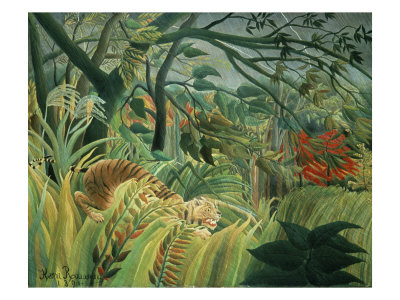
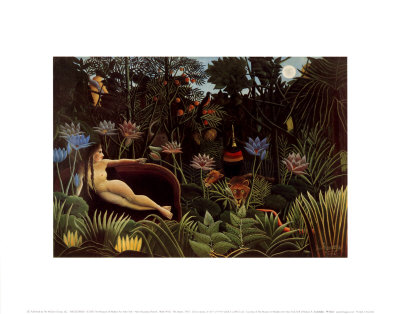
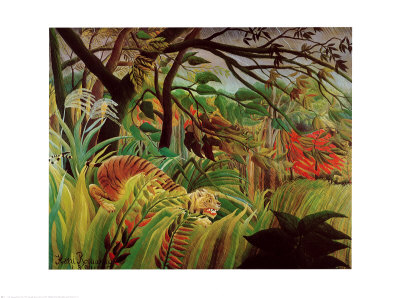
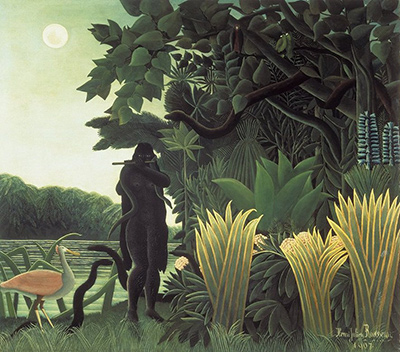
The most significant evolution in Rousseau's career occurred when he turned his attention to the tropical jungle. This period, which spans roughly from 1891 to 1900, represents the zenith of his creative output and the most recognizable aspect of his oeuvre. In these works, the jungle is no longer just a background; it is a living, breathing character that exerts a powerful influence over the human figures within it. The dense foliage is rendered with heavy, dark greens and blacks, creating a claustrophobic atmosphere that contrasts sharply with the bright, almost neon colors of the flowers and the sleeping figures.
Rousseau's approach to the jungle was one of synthesis, combining elements from his own garden in Le Havre with exotic flora he had seen in illustrations and travelogues. He simplified the forms of the animals and plants, reducing them to bold shapes and flat areas of color. This simplification was not a lack of skill, but a conscious decision to prioritize the emotional impact of the scene over anatomical accuracy. The result was a visual experience that felt dreamlike and detached from reality, inviting the viewer to enter a world that existed only in the realm of fantasy.
To understand the mechanics of this evolution, one can observe the following key characteristics that defined his jungle period:
- The introduction of thick, impasto brushwork that prevented the canvas from appearing flat or two-dimensional.
- The use of non-naturalistic color palettes where green and black dominated the background to create depth.
- The placement of figures in the foreground, often sleeping or resting, to contrast with the chaotic nature behind them.
- The complete abandonment of linear perspective in favor of a "flat" composition where objects overlap without clear spatial logic.
- The inclusion of specific botanical elements like hibiscus and birds that were impossible in a French garden, sourced from exotic prints.
The Mature Style: Dreaming in Color
In his final years, Rousseau's style matured into a highly consistent and recognizable mode. The jagged outlines and heavy black shadows that defined his earlier work became more refined, creating a rhythmic quality to the composition. He became a master of color harmony, using complementary colors to create vibrancy without overwhelming the eye. The sleeping figures, often gypsies or men reclining in hammocks, became central motifs, symbolizing a peaceful existence untouched by the chaos of modern society.
These late works are characterized by a sense of stillness and timelessness. The action has stopped; the world is suspended in a moment of quietude. The viewer is invited to linger in the painting, observing the intricate details of the vines, the texture of the fabrics, and the serene expressions of the figures. This period demonstrated his complete command over the brush, allowing him to execute complex scenes with a fluidity and confidence that was rare for an artist who had spent much of his life working behind the scenes of the railway station.
The Legacy of a Silent Observer
Ultimately, the evolution of Henri Rousseau's style is a testament to the power of the individual artist to transcend the limitations of his time and environment. From the tentative strokes of an Impressionist apprentice to the bold, confident declarations of a jungle dreamer, his career charted a clear path of artistic autonomy. By stripping away the complexities of realistic representation, he created a visual language that continues to captivate audiences today. His work serves as a practical example of how an artist can transform a mundane reality into a profound spiritual experience, proving that the most important landscapes are often found within the mind itself.
Related reading
- The Digital Brush: Reimagining the Dream World of Rousseau
- The Child in the Jungle: Cultivating the Spirit of Naïve Art
- Finding Your Own Wild Garden: A Guide to Choosing Subjects in Naïve Art
- The Artist's Canvas: Unveiling the Essentials of Naïve Creation
- Unlocking the Surreal Garden: A Guide to Finding Historical Naïve Art for Inspiration