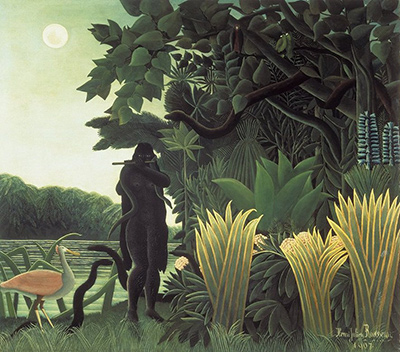
Henri Rousseau's 1907 masterpiece, The Snake Charmer, stands as a testament to the enduring power of imagination over reality, capturing a moment of intense stillness that feels far more alive than the bustling Parisian streets where it was painted. This unique work, created in the artist's later years, reflects a deepening obsession with the exotic and the mysterious, showcasing his distinct ability to blend naive simplicity with a complex, almost hallucinatory atmosphere. By examining the composition, the brushwork, and the psychological tension within the canvas, we can better understand how Rousseau transformed his fascination with the occult and the jungle into a visual symphony that continues to captivate audiences centuries later.
The Architecture of Silence
At first glance, The Snake Charmer appears to be a straightforward depiction of a man surrounded by nature, yet upon closer inspection, the composition reveals a carefully constructed architecture of silence and tension. Rousseau does not merely paint the scene; he builds a stage where the snake charmer is the sole actor, and the surrounding flora are the silent witnesses. The man, seated on a simple wooden stool, occupies the center of the canvas, his posture rigid and his eyes fixed forward, suggesting a trance-like state or a deep concentration that transcends the physical act of playing his instrument.
The background is a masterclass in spatial ambiguity, a hallmark of Rousseau's style. Trees with bulbous, rounded canopies frame the scene, their forms softened and blended in a way that defies strict botanical accuracy. This lack of precise detail creates a dreamlike quality, inviting the viewer to project their own interpretations onto the environment. The lighting is diffuse, devoid of harsh shadows, which contributes to the ethereal mood. There is no clear source of light illuminating the charmer from above; instead, the scene seems to exist in its own internal glow, a self-contained universe where time seems to have slowed down to a crawl.
The Psychology of the Occult
The central figure of the snake charmer embodies the very essence of the painting's theme: the intersection of human will and the forces of nature. In the 19th and early 20th centuries, the practice of snake charming was often viewed with a mixture of wonder and superstition, particularly in the French art world where Rousseau found himself. He was not merely documenting a cultural practice; he was exploring the concept of control and influence, the subtle arts of seduction and domination inherent in the ritual.
The man's expression is crucial to understanding the narrative. He is not smiling, nor is he grimacing in pain. His face is neutral, almost vacant, which paradoxically makes the scene feel more intense. This lack of overt emotion suggests that the true battle is happening invisibly between the flute and the serpent. The snake, coiled tightly around the musician's arm, is rendered with a fluid, almost liquid quality, its scales shimmering with a metallic sheen. The contrast between the organic, breathing form of the snake and the rigid, static pose of the man creates a dynamic tension that pulls the viewer into the scene. It raises the question of whether the charmer is truly in control or if he is merely a vessel for the serpent's energy, a duality that adds a layer of philosophical depth to the artwork.
The Role of Color and Texture
Rousseau's use of color in The Snake Charmer is equally significant, moving beyond mere representation to serve an emotional purpose. The palette is dominated by earthy greens, browns, and ochres, colors that ground the painting in the natural world while simultaneously feeling slightly artificial and stylized. The greens of the foliage are not the vibrant, chlorophyll-rich greens of a tropical rainforest but rather muted, olive tones that blend seamlessly into the shadows. This choice helps to unify the composition and prevents the viewer from getting distracted by unrealistic details.
Texture plays a vital role in establishing the atmosphere. Rousseau's brushwork varies significantly across the canvas. In the foliage, the strokes are broad, sweeping, and confident, giving the impression of thick, textured paint that seems to ripple in the breeze. In contrast, the areas around the snake charmer are rendered with more delicate, precise lines, highlighting the isolation of the figure. The snake itself is painted with a mix of these techniques; its body has the softness of the leaves, yet its head is defined with sharp, distinct strokes that give it a sense of alertness and danger. This juxtaposition of softness and sharpness mirrors the duality of the scene itself—the peaceful setting hiding a latent threat.
The Evolution of a Style
Understanding The Snake Charmer requires contextualizing it within the trajectory of Henri Rousseau's career. Initially known as the "Mad Painter" for his unconventional approach to art, Rousseau began his career painting scenes from his garden in Montmartre. However, as he traveled to the French colonies in Indochina in the late 1880s, his subject matter expanded dramatically. He spent years collecting specimens, studying local flora and fauna, and sketching the people he encountered.
By 1907, Rousseau was well past his prime in terms of physical health and social recognition, yet his creative output had only intensified. The Snake Charmer represents a mature synthesis of his earlier naive style with a more sophisticated understanding of composition and color theory. He had learned from the masters, yet he maintained his unique voice, refusing to conform to the academic standards of the Salon. The painting is a culmination of decades of study, observation, and a lifelong dream of escaping the constraints of the city to live in the jungle. It is a reminder that true artistry lies in the freedom to imagine, regardless of one's age or physical limitations.
A Timeless Legacy
Today, The Snake Charmer remains one of the most recognizable works in the history of naive art, a visual anchor for those interested in the intersection of fantasy and reality. Its enduring appeal lies in its ability to transport the viewer to a place that exists only in the mind, a realm where the laws of physics are secondary to the power of the imagination. Whether viewed in a museum gallery or in the privacy of one's home, the painting continues to evoke a sense of mystery and awe.
For artists and enthusiasts alike, studying this work offers valuable lessons on composition, the use of color, and the power of suggestion. It teaches us that we do not always need to depict the world as it is to make it feel real. In The Snake Charmer, Rousseau has created a world that is both familiar and alien, a perfect blend of the known and the unknown that continues to inspire new generations of dreamers and creators. The snake charmer may have long since disappeared into the history of forgotten expeditions, but his story, painted in oil on canvas, remains as vivid and alive as the day it was first created.
Key Takeaways from the Analysis
To truly grasp the significance of this piece, one must consider several critical elements that define its artistic success:
-
The deliberate use of flattened perspective creates a timeless, almost static quality that defies traditional depth.
-
The muted, earthy color palette evokes a sense of ancient mystery rather than immediate realism.
-
The fluid, almost liquid rendering of the snake contrasts sharply with the rigid posture of the human figure.
-
Rousseau's unique brushwork blends broad, confident strokes with delicate, precise lines to unify the composition.
-
The psychological tension between control and surrender is the central narrative thread throughout the canvas.
-
The absence of a distinct light source creates an internal, self-contained glow that isolates the figure.
-
The background vegetation acts as a silent witness, framing the scene without interfering with the action.
-
The painting challenges the viewer to question the reality of the depicted events.
-
Rousseau's personal history with the jungle provides a unique context for the exotic subject matter.
-
The work serves as a bridge between the artist's naive style and a more mature, complex emotional depth.