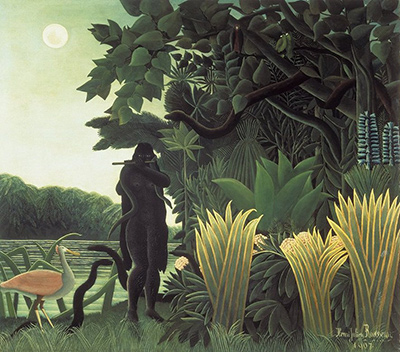
Henri Rousseau's world is a vibrant tapestry woven with dreamlike logic, where the boundaries between reality and imagination dissolve into a singular, hypnotic atmosphere. Among his most evocative subjects are the gypsies, figures who often appear in his work not merely as people, but as carriers of mysterious legends and nocturnal secrets. When examining the narrative behind his "Sleeping Gypsy," one finds a composition that speaks less of a specific historical event and more of a universal, fleeting moment of peace in a chaotic world.
The Art of the Suspended Moment
Rousseau possessed a unique gift for capturing stillness amidst motion, a quality that defines his approach to the sleeping gypsy. Unlike the frantic energy often found in Impressionist gatherings, his subjects are frozen in time, their bodies relaxed in poses that suggest a deep, almost unnatural slumber. This technique invites the viewer to step into a narrative where the character is unaware of the world outside their tent or caravan, creating a sense of isolation that is both poignant and fascinating. The artist does not just paint a person; he paints a story written in posture and shadow, where the act of sleeping becomes the primary subject of inquiry.
Decoding the Visual Language of Rest
To understand the story of the sleeping gypsy, one must look closely at the interplay of light and the specific details of the camp environment. Rousseau was a master of this contrast, using bright highlights against deep, velvety shadows to create depth and mystery. In many of his gypsy scenes, the lighting suggests a late afternoon sun casting long shadows, or perhaps the soft glow of a campfire long extinguished. These visual cues tell us that the gypsy is not merely resting but is in a state of transition, perhaps preparing for the journey ahead or having just arrived from one. The surrounding environment, filled with stuffed animals, blankets, and personal effects, serves as a backdrop that speaks to the gypsy's nomadic lifestyle and the treasures they carry from village to village.
The Symbolism of the Tent and Campsite
The setting itself is a crucial narrative device in Rousseau's oeuvre. The tent is never just a shelter; it is a portable home, a sanctuary, and a stage for the gypsy's daily life. In the context of the sleeping gypsy, the tent becomes a cocoon, a protective shell where the outside world's demands do not intrude. The arrangement of objects within this space tells a specific story about the individual's personality and history. A well-arranged camp suggests a life of order despite the chaos of travel, while a cluttered one might hint at the accumulation of years and the weight of the past. By focusing on these domestic details, Rousseau elevates the gypsy from a stereotypical caricature to a complex character with a rich inner life.
The Psychology of the Nomad in Art
Beyond the visual elements, the sleeping gypsy represents a psychological state that has long intrigued artists and observers alike. There is an inherent tension in the image of a nomadic people, who are constantly on the move, suddenly found in a moment of absolute stillness. This contrast creates a narrative arc within a single frame, inviting the viewer to wonder about the days leading up to this sleep and the dreams held within it. Rousseau explores themes of transience and the human need for rest, regardless of one's status in the world. The gypsy, often marginalized in society, is given a moment of dignity and peace, a quiet rebellion against the noise and rush of daily existence. This empathetic portrayal allows the audience to connect with the figure on a human level, transcending cultural stereotypes.
Collecting Insights from the Master's Style
For those interested in studying these works or understanding the broader context of gypsy art in the 19th century, there are several key takeaways to consider when analyzing such paintings. The approach involves looking at the brushwork, the color palette, and the composition to uncover the story the artist intended to tell.
- Observe the texture of the canvas and the application of paint to gauge the artist's speed and intent.
- Note the use of color to determine the time of day and the emotional tone of the scene.
- Analyze the positioning of the figures to understand the social dynamics at play within the camp.
- Consider the historical context of the gypsy population in France during Rousseau's lifetime.
- Compare the sleeping figure with other gypsy scenes to identify recurring themes and motifs.
By engaging with these elements, one can appreciate the depth of Rousseau's vision and the enduring power of his depictions of the sleeping gypsy. The work stands as a testament to the artist's ability to find the extraordinary in the ordinary, capturing a fleeting moment that resonates with the viewer long after the painting has been viewed.