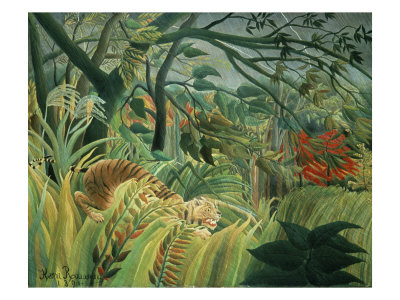
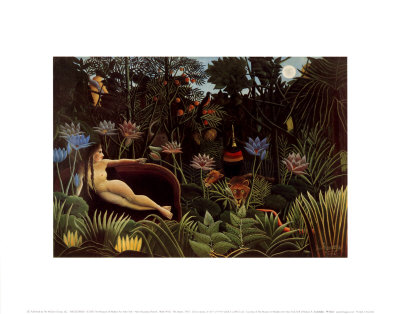
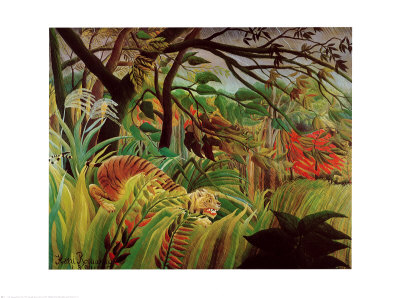
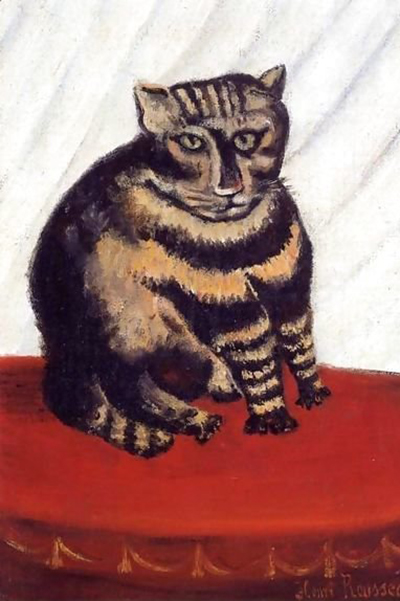
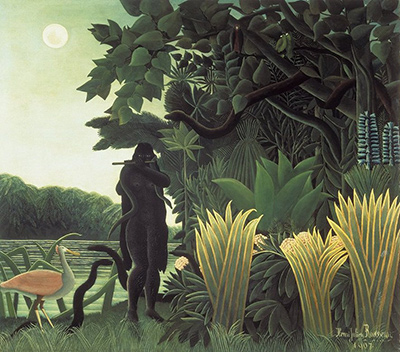
Henri Rousseau, often hailed as the king of naivety, did not merely paint exotic jungles; he inadvertently dismantled the rigid structures of his time to reveal a new, intuitive way of seeing the world. His unique vision emerged not in isolation but as a fascinating, if somewhat misunderstood, thread within the complex tapestry of post-impressionism, bridging the gap between the raw observation of nature and the internal landscapes of the modern soul. To truly understand the man behind the painted tigers and swaying palms, one must look beyond the surface of his "naive" style and recognize how his work both challenged and was shaped by the revolutionary spirit of the late nineteenth century.
The Gilded Cage of Academic Tradition
Before Rousseau could break free, he was firmly entrenched in the stifling conventions of the French Academy, a system that valued technical perfection over artistic expression and often relegated nature studies to mere preparatory exercises for historical or mythological subjects. As a member of the "School of Paris" during his youth, he was expected to adhere to strict rules regarding perspective, anatomy, and color theory, creating a sense of artificiality that he eventually found suffocating. This background in traditional art education became the very foundation upon which he would later build his rebellion, as his inability to conform to the expected standards of his peers forced him to develop a personal language of painting that prioritized emotional truth over academic correctness.
The Garden of Innocence
Rousseau's most defining characteristic was his ability to infuse his subjects with a profound sense of wonder and innocence, qualities that stood in stark contrast to the cynicism of the urban industrial age. He often painted scenes from the Parisian gardens where he walked daily, transforming mundane spots into enchanted realms filled with vibrant life. This obsession with the garden was not just a hobby but a philosophical stance; he believed that nature possessed an inherent spirituality that could only be captured through direct observation and an unclouded imagination. His work suggests a deep connection to the natural world, where the flora and fauna appear almost alive and aware, inviting the viewer to step into a world that exists outside the constraints of logic and human intervention.
The Unseen Masters
While Rousseau is frequently celebrated as a solitary genius, his development was significantly influenced by a group of artists known as the "Unseen Masters," a collective of painters who met in the studio of Maurice Denuelle. These artists, including Pierre Bonnard and Édouard Vuillard, shared a similar desire to explore the interplay of light and color in natural settings, though they approached the subject with different stylistic nuances. The influence of this circle was crucial in shifting the focus from the grand historical narratives of the past to the immediate, sensory experience of the present moment. Their collective experimentation laid the groundwork for the diverse interpretations of nature that would soon define the post-impressionist movement, proving that a single artist's vision could resonate with a broader artistic community.
The Bridge to Modernism
The transition from the Impressionist movement to Post-Impressionism was characterized by a search for deeper meaning and structural integrity in art, a shift that Rousseau inadvertently participated in through his distinctive approach. Although he was not a conscious member of any specific avant-garde group, his bold use of flat areas of color, simplified forms, and non-naturalistic lighting anticipated the developments seen in Fauvism and Cubism. His work serves as a testament to the power of individual expression, demonstrating that true artistry does not require adherence to a manifesto or a specific school of thought. By blending the realistic depiction of his subjects with a heightened sense of imagination, Rousseau created a unique visual poetry that continues to captivate audiences, proving that the most radical art often comes from the most sincere places.
The Legacy of Naivety
The concept of "naivety" attached to Rousseau's name is often a misnomer that obscures the sophisticated techniques and deliberate choices he made throughout his career. His work is not the result of ignorance or a lack of training, but rather a conscious decision to bypass the complexities of academic art in favor of a raw, emotional honesty. This choice allowed him to tap into a universal language of nature that transcends cultural and temporal boundaries. Today, his paintings stand as a reminder that art is fundamentally about the artist's unique perspective and their relationship with the world around them. Whether he is painting a dense jungle or a quiet garden, the underlying message remains the same: there is magic in the ordinary if one knows how to look.
To appreciate Rousseau fully, one must set aside the initial confusion of his style and engage with the feelings he evokes. His art invites us to slow down and observe the world with fresh eyes, to find beauty in the unexpected, and to recognize that the most profound truths often lie in the simplest forms. In doing so, we join him in his eternal exploration of the unknown, finding solace and inspiration in the silent, swaying forests he painted with such intense vitality and belief. His journey from the academic ranks to the forefront of modern art history is a powerful example of how true creativity can emerge from the constraints of tradition and blossom into something entirely new and enduring.
Key Takeaways for Understanding Rousseau
For students and enthusiasts navigating the post-impressionist landscape, it is essential to grasp the specific nuances that define Rousseau's contribution. Rather than viewing him solely as a misfit, consider these critical points that illuminate his historical position:
- Rousseau rejected the rigid academic rules of perspective and proportion that dominated his training.
- His work focuses heavily on the psychological impact of nature rather than its scientific accuracy.
- The "naive" label is a retrospective construct that ignores his years of self-taught study and practice.
- His isolationism allowed for a unique synthesis of realism and fantasy that few of his peers achieved.
- The influence of his garden surroundings provided the consistent thematic anchor for his entire body of work.
By internalizing these facts, one moves closer to appreciating the deliberate craftsmanship behind his seemingly simple strokes. His art invites us to slow down and observe the world with fresh eyes, to find beauty in the unexpected, and to recognize that the most profound truths often lie in the simplest forms. In doing so, we join him in his eternal exploration of the unknown, finding solace and inspiration in the silent, swaying forests he painted with such intense vitality and belief. His journey from the academic ranks to the forefront of modern art history is a powerful example of how true creativity can emerge from the constraints of tradition and blossom into something entirely new and enduring.
Related reading
- The Digital Brush: Reimagining the Dream World of Rousseau
- The Child in the Jungle: Cultivating the Spirit of Naïve Art
- Finding Your Own Wild Garden: A Guide to Choosing Subjects in Naïve Art
- The Artist's Canvas: Unveiling the Essentials of Naïve Creation
- Unlocking the Surreal Garden: A Guide to Finding Historical Naïve Art for Inspiration