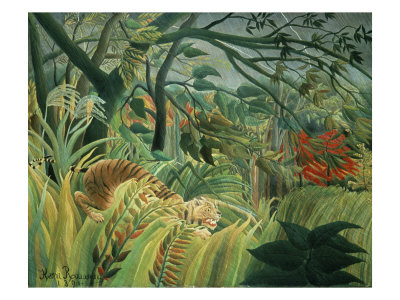
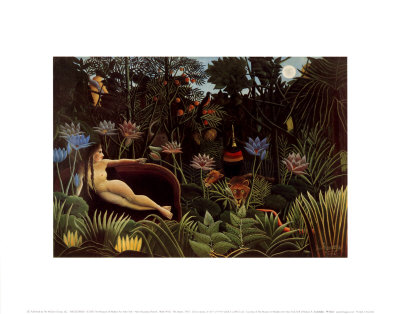
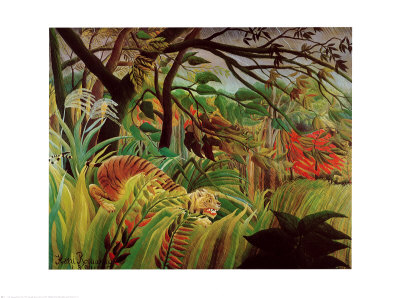
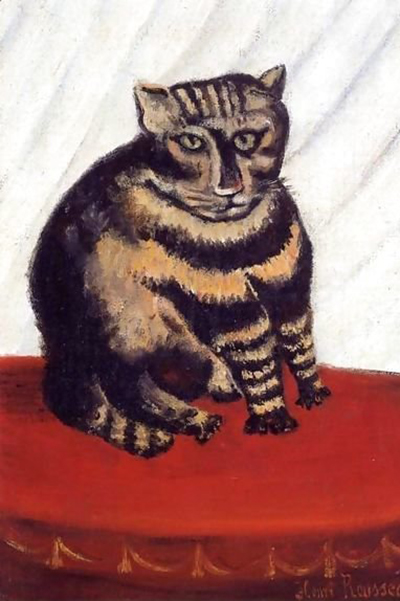
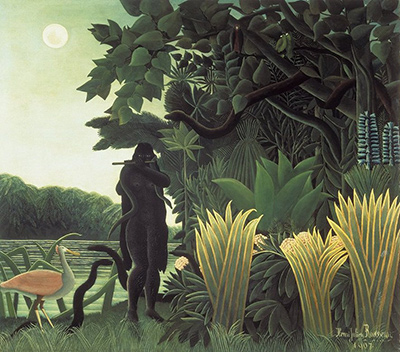
Henri Rousseau stands as a peculiar anomaly in the vast landscape of art history, a man whose reputation often precedes his work, a man whose genius is frequently misunderstood by those who approach it with the eyes of a critic rather than the heart of a dreamer. Yet, beyond the initial shock of his jagged outlines and dreamlike forests, there lies a profound and undeniable influence on the trajectory of modern art, challenging the very notion of how a work of art should be seen and interpreted. His legacy is not merely in the paintings he left behind, but in the seismic shift he caused in the collective consciousness of artists and viewers alike, proving that technical perfection was not the only path to truth.
The Rejection of Academic Rigidity
Before Rousseau, the art world was dominated by the rigid structures of the Parisian Academy, where precision, perspective, and adherence to classical anatomy were the only laws of creation. Rousseau, however, approached the canvas as if it were a window into a private, internal world rather than a study of the external reality. This refusal to conform to the rules of the establishment was revolutionary. He did not seek to teach the viewer how to look; instead, he taught them to feel. His work suggested that the truth of an experience often lies in the artist's emotional reaction to it, rather than in the objective rendering of that experience. This shift laid the groundwork for Expressionism, a movement that would shortly after emerge from the shadows of the French capital, prioritizing emotional truth over visual accuracy.
The Birth of the Dream State
Perhaps the most significant contribution Rousseau made to modern art was the articulation of the unconscious mind. His paintings, filled with lush vegetation, menacing birds, and isolated figures, possessed a surreal quality that felt entirely new to the public at the time. He painted his visions while sleeping, or perhaps in a state of intense, feverish creativity, resulting in compositions that seemed to defy logic and physics. This approach directly inspired the Surrealists, a group of artists who would later dedicate themselves to exploring the irrational and the dreamlike. Artists like Salvador Dalí and René Magritte found in Rousseau's work a blueprint for creating images that operated outside the bounds of normal perception, suggesting that the mind could construct realities far more vivid and terrifying than the waking world.
The Language of the Naive
Rousseau's style, often mislabeled as "naive" by critics who found his lack of academic training annoying, actually represents a distinct and powerful visual language. He used thick, impasto brushstrokes that caught the light, creating a texture that was both physical and psychological. His figures were often depicted with oversized heads and elongated limbs, a simplification that stripped away the clutter of detail to reveal the essence of the subject. This reduction of form influenced a generation of artists who sought to strip art down to its most primal elements. The Fauves, with their bold colors and simplified forms, and later the Cubists, who broke down objects into geometric planes, were all echoing the same impulse that Rousseau had started: the idea that art is about communication, not about replication.
The Primacy of the Artist's Vision
At the core of Rousseau's influence is the radical concept that the artist's vision is paramount, regardless of the artist's background or training. He was a tax collector, a man of the law, who possessed no formal training in drawing or perspective, yet he created some of the most famous images of the 19th century. This reality shattered the myth of the genius as a born, untouchable entity and opened the door for the "genius" to be anyone, anywhere. It democratized the idea of artistic creation, suggesting that the spark of inspiration is universal. His success proved that one could bypass the filters of the academy and speak directly to the soul of the viewer through the raw power of imagination. This paved the way for the Dadaists and the Abstract Expressionists who followed, who would continue to push the boundaries of what art could be, freed from the shackles of traditional technique.
The Enduring Legacy
The impact of Henri Rousseau extends far beyond the specific techniques he employed or the subjects he chose. He fundamentally changed the way we think about the relationship between the viewer and the artwork. By presenting images that felt immediate, urgent, and deeply personal, he invited the audience to participate in the creation of meaning rather than passively consuming a polished image. His work remains a testament to the power of the individual imagination to reshape the world. Today, when we look at a painting that seems to exist in a dream, or when we appreciate the raw, unpolished honesty of a modern masterpiece, we are walking a path that Rousseau blazed decades ago. He taught us that the most important thing an artist can do is to see the world as they see it, and to paint it with the courage to be different.
To truly understand the magnitude of his contribution, one must consider how his specific methods resonated across different movements. The following points illustrate the key mechanisms by which his work acted as a catalyst for change:
- The deliberate avoidance of realistic perspective to prioritize emotional immediacy.
- The use of dense, textured brushwork to create a tactile, psychological presence.
- The inclusion of impossible, dream-like spatial arrangements that defied gravity.
- The depiction of solitary figures facing vast, overwhelming natural forces.
- The transformation of everyday jungle scenes into landscapes of psychological tension.
- The rejection of the artist as a master craftsman in favor of the artist as a visionary dreamer.
- The belief that the "naive" eye can perceive a higher truth than the trained academic.
These elements combined to dismantle the hierarchy that placed technique above expression. By validating the raw, unfiltered output of a man with no formal schooling, Rousseau gave permission to thousands of others to follow their own instincts, regardless of their background. He showed that art was not about mimicking the visible world, but about translating the invisible world of the mind onto the surface. This democratization of creativity allowed movements like Fauvism and Cubism to flourish, as artists felt emboldened to break rules they had never even known existed. The jungle of his mind became the garden of modern creativity, where the seeds of Surrealism were sown in the soil of the naive.
Related reading
- The Digital Brush: Reimagining the Dream World of Rousseau
- The Child in the Jungle: Cultivating the Spirit of Naïve Art
- Finding Your Own Wild Garden: A Guide to Choosing Subjects in Naïve Art
- The Artist's Canvas: Unveiling the Essentials of Naïve Creation
- Unlocking the Surreal Garden: A Guide to Finding Historical Naïve Art for Inspiration