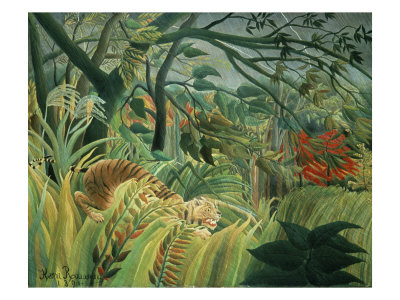
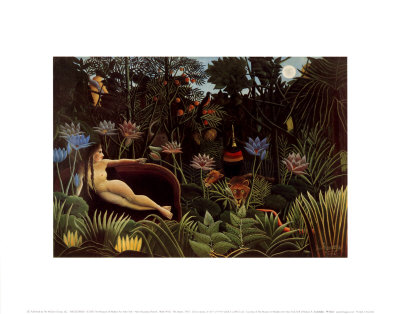
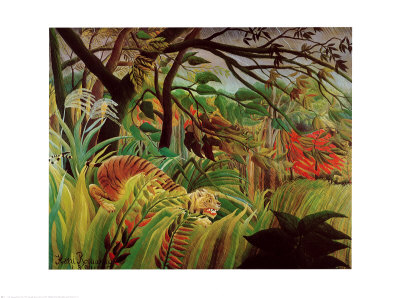
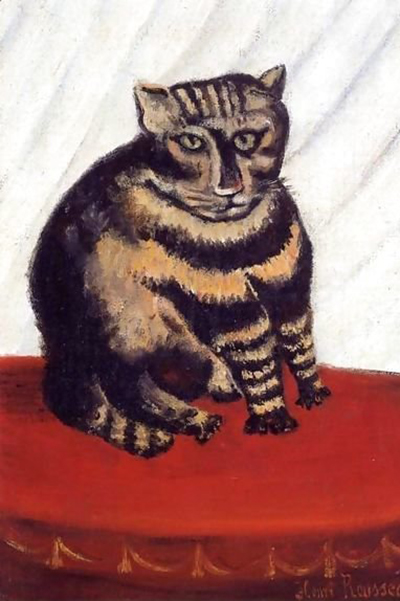
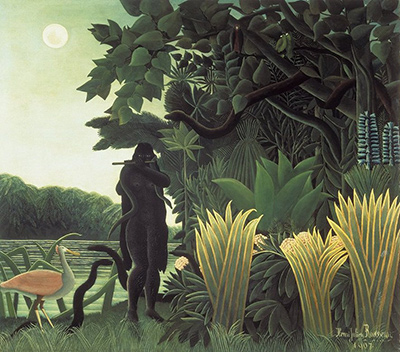
To paint a tree that seems to erupt from the earth without any visible root system is to tap into the very heart of Henri Rousseau's imagination. His work teaches us that nature does not always obey the laws of logic or gravity; sometimes, it simply appears, bold and unapologetic, defying the horizon. Mastering this effect requires abandoning strict realism in favor of a sense of mystery and sudden revelation. When you wish to render trees that grow out of nowhere, you must embrace the feeling of surprise that the great French Impressionist so masterfully evoked in his nightmares and his dreams. The goal is not to show how the tree physically attaches to the ground, but rather to convey the sudden, shocking presence of life interrupting the quiet stillness of the scene. This technique transforms the canvas into a landscape where the impossible becomes plausible, inviting the viewer to lean in closer to find clues that cannot be found.
Mastering the Illusion of Depth
The first step in creating these impossible trees is to manipulate the sense of depth on the canvas. In a realistic painting, roots are expected to curve down into the soil, anchoring the trunk firmly to the surface. To achieve the "out of nowhere" effect, you must deliberately omit these connections. Instead, position the trunk so that it emerges from behind a cluster of leaves, a shadow, or directly from the top edge of the composition. This placement tricks the eye into assuming the tree is rising from the ground below the frame or from behind a hidden element. By removing the visual evidence of roots, you create a vacuum of explanation that the brain naturally fills with wonder. The tree exists independently of the soil's logic, hovering in a space that feels both intimate and distant. Pay close attention to the layering of forms; ensure that the foliage in front of the trunk is rendered with sharp, confident strokes while the base fades or disappears entirely. This contrast between the defined upper structure and the vanishing lower structure is crucial for maintaining the surreal atmosphere.
The Power of Shadows and Silhouettes
Henri Rousseau often used deep, dark shadows to suggest the presence of objects that are not clearly defined. When painting a tree that grows from nowhere, utilize shadows not just to define form, but to hide the mechanism of its growth. A heavy, black shadow directly beneath the trunk can imply that the tree is sinking into the earth or that the ground is obscured by darkness, allowing the foliage to pop out as if it has materialized from the void. Conversely, you can use a bright, blinding light source that washes out the lower portion of the tree, making it seem as though it is emerging from a cloud of fog or a burst of light. The interplay between light and shadow is the primary tool for this illusion. If the shadow is too soft, the tree may look too grounded and naturalistic. If the shadow is too harsh, it can feel too artificial. The key is to strike a balance where the shadow suggests mystery rather than obstruction. In some areas, you might leave the canvas blank or apply a very thin layer of paint to represent the unseen base, letting the imagination complete the picture.
Techniques for Ethereal Growth
There are several specific techniques you can employ to enhance the ethereal quality of these spontaneous trees. First, consider the direction of the foliage; instead of growing uniformly downward or outward, allow the branches to twist and turn in directions that seem almost random, as if they are reaching for an invisible sky. Second, vary the texture of the bark versus the leaves; a rough, detailed trunk can contrast sharply with soft, blurred leaves to emphasize the magical nature of the scene. Third, incorporate elements like vines or tendrils that seem to float in the air before snatching hold of the trunk, adding to the sense of movement and suddenness. Below is a list of practical methods to help you refine your composition:
- Use a flat brush to create quick, decisive strokes for the upper canopy, ensuring they feel heavy and immediate.
- Apply a thin, watery wash to the base of the tree to create a fading effect that disappears into the background.
- Introduce unexpected colors in the lower sections, such as a splash of blue or pink, to break the natural color palette of earth and bark.
- Leave small, intentional gaps in the foliage near the base to suggest the tree is passing through something unseen.
- Experiment with overlapping shapes so that the tree appears to be growing behind a rock, a bush, or a tree trunk itself.
Breaking the Rules of Perspective
Perspective is another powerful ally in your quest to paint trees that defy gravity. Standard linear perspective dictates that objects further away appear smaller and that ground planes recede at a consistent angle. To make a tree grow out of nowhere, you might deliberately flatten the perspective, making the ground plane horizontal and preventing the tree from touching it. Alternatively, you can distort the vertical lines of the trunk, making them curve slightly upward or downward as they ascend. This distortion creates a sense of instability, reinforcing the idea that the tree is not subject to normal physical laws. You can also layer multiple trees of different sizes in close proximity, ignoring proper scaling, to create a chaotic, dreamlike forest where the rules of nature are suspended. The most effective way to pull this off is to rely on the viewer's perception of light and shadow rather than strict geometric rules. When the viewer focuses on the glowing leaves and the dramatic lighting, they will overlook the absence of roots and the weird angles of the trunk.
Embracing the Surreal Spirit
Ultimately, the most important element in painting trees that grow out of nowhere is spirit. You must channel the same sense of wonder and surprise that Henri Rousseau brought to his paintings. It is not enough to simply copy the technique; you must understand the emotion behind the imagery. The tree should feel alive, breathing, and full of energy, as if it has just been planted by an invisible hand moments before the viewer arrived. Take your time with the brush, allowing the paint to flow freely and unpredictably, mimicking the chaotic growth of these fantastical plants. Trust your instincts, and do not be afraid to make mistakes, for in the world of naive art and surrealism, imperfection often adds to the charm. By combining the techniques of depth manipulation, shadow play, and perspective distortion with a genuine sense of mystery, you can create landscapes that remain as captivating and inexplicable as the dreams of the great French artist. Let your canvas become a place where nature does not follow rules, but rather creates them anew.