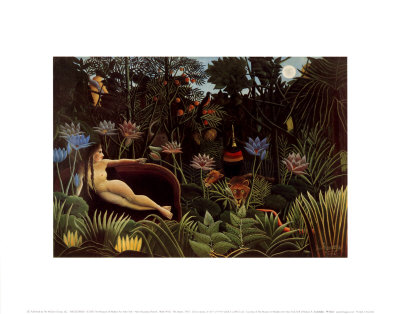
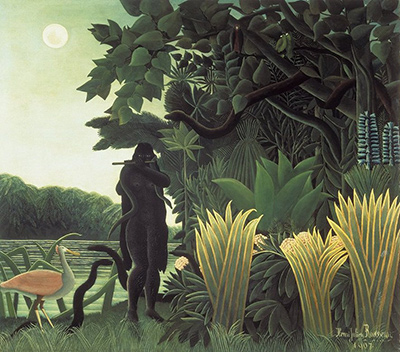
When first encountering the work of Henri Rousseau, many beginners are struck by an immediate sense of wonder, often mistaking his style for a childlike fantasy or a mere dream captured on canvas. This initial confusion is entirely understandable, as his unique approach defies the rigorous rules of academic painting that dominated the art world of his time. By understanding the core philosophy behind his "naive" style, one can begin to appreciate the profound depth hidden within what appears to be simple, unrefined brushwork.
The Myth of Innocence
The term "naive art" is frequently misunderstood, leading many to believe that these works lack intelligence or technical skill. In reality, the label "naive" was originally applied by critics to describe artists who were completely untrained in the traditional academies of France, yet possessed a raw, honest vision that was free from the rigid conventions of their era. For Henri Rousseau, this lack of formal training was not a deficiency but a liberation. He did not worry about perspective, foreshortening, or color theory as dictated by the masters of his day; instead, he painted exactly as he saw it, or rather, exactly as he imagined it to be. This freedom allowed him to create landscapes and jungle scenes that felt alive with a surreal energy, transporting the viewer to places that existed only in his mind's eye.
Mastering the Untrained Eye
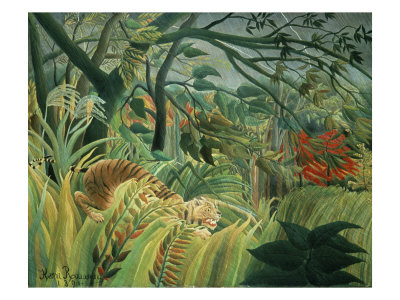
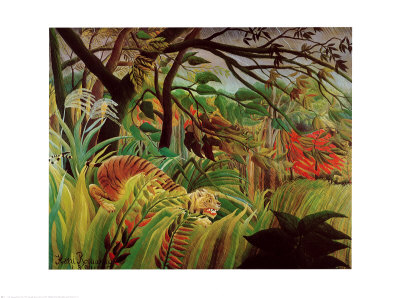
To truly engage with Rousseau's oeuvre, one must shift their focus from technical perfection to emotional resonance and compositional harmony. Beginners should look for the specific way he handles light, often flattening the background to make the animals and figures appear to step out toward the viewer. His trees are often depicted with thick, textured strokes that feel almost sculptural, while his birds and monkeys are rendered with delicate precision that belies the lack of formal schooling. This juxtaposition of rough textures and fine details creates a dynamic tension that is central to his appeal. When studying his work, ignore the mistakes you might identify in a traditional art class; instead, ask yourself how the colors interact and how the shapes guide your eye through the canvas.
A Journey Through the Jungle
One of the most captivating aspects of Rousseau's career was his fascination with the exotic, a theme that became his signature. While he never traveled to the jungles of South America or Africa, he constructed these environments through a meticulous study of natural history books, illustrations, and the curiosity of the people in his daily life. He would sketch exotic birds and flowers in his garden and then weave them into larger, imaginary scenes filled with mystery and movement. This process of translation from reality to imagination is where his true genius lies. It challenges the viewer to question the line between observation and invention, creating a world where a jaguar might stare directly at the observer, or where a flock of birds seems to be fleeing from something unseen.
How to Analyze His Compositions
To deepen your understanding of his techniques, you can adopt a simple method of observation that focuses on three specific elements: line, color, and space. By breaking down the visual structure, you can see the deliberate choices Rousseau made to create his distinctive atmosphere.
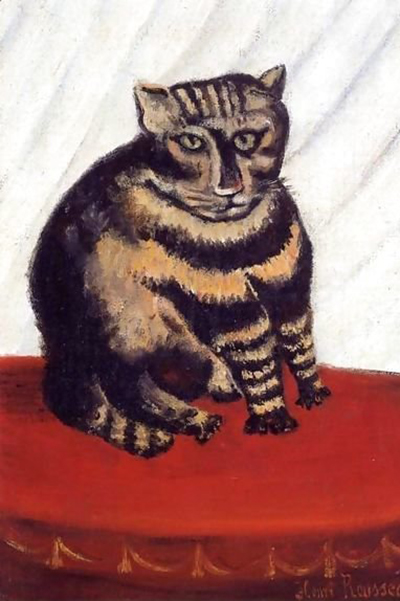
- Observe the Lines: Notice how Rousseau often uses thick, dark outlines to define forms, which gives a sense of solidity and permanence to the subjects.
- Analyze the Colors: Look for the use of bright, saturated colors against often muted or solid backgrounds, creating a high-contrast visual impact.
- Check the Space: Pay attention to how he compresses the space, eliminating deep backgrounds to make the foreground elements pop with immediate clarity.
- Focus on the Animals: Rousseau often gave his animals a personality that feels both wild and curious, making them the heroes of the scene.
- Ignore the Trees: The background foliage is often treated as a pattern rather than a realistic representation of nature, serving to frame the main subjects.
- Consider the Mood: Ask yourself what emotion the scene evokes; is it peaceful, tense, or mysterious?
The Legacy of the Dreamer
Henri Rousseau's life was marked by a deep introspection and a constant struggle to be taken seriously by the establishment, yet his work remains one of the most accessible and moving in the history of art. He created a sanctuary for the imagination, a place where logic yields to dream and the impossible becomes beautiful. For the modern viewer, his art serves as a reminder that we do not need to follow the rules of the academy to express something profound. By embracing the untrained perspective, we can unlock a world of visual poetry that speaks directly to our innermost thoughts. Whether you are an aspiring artist or simply a curious observer, Rousseau invites you to look beyond the surface and find the magic in the mundane, proving that the simplest brushstrokes can tell the most extraordinary stories.