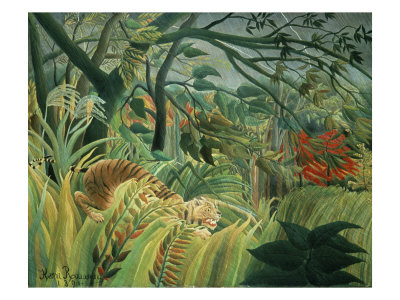
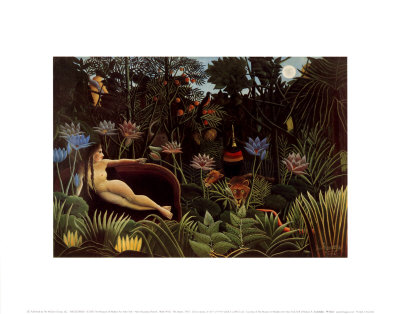
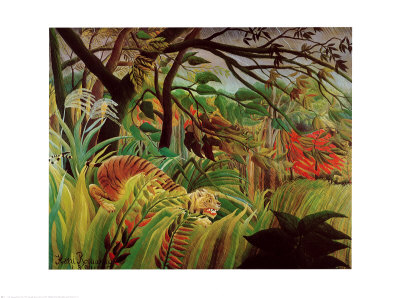
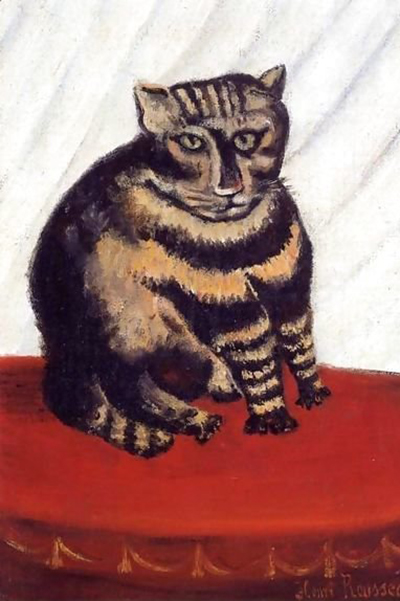
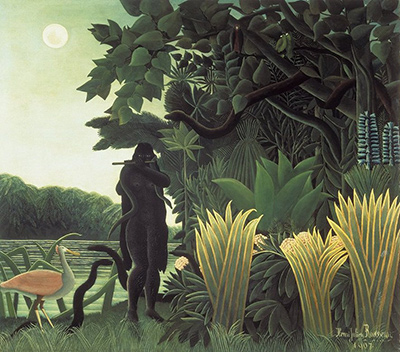
Henri Rousseau, the French painter known for his dreamlike forests and enigmatic night scenes, offers a unique perspective on the vastness of nature that transcends the turbulence of the Impressionists. While many masters depicted the churning energy of the ocean with heavy brushstrokes and dynamic movements, Rousseau approached the sea with a sense of quiet introspection, creating compositions that feel suspended in time. To emulate this specific atmospheric quality in one's own work, one must look away from the chaotic waves of the real world and toward the psychological space where the viewer meets the infinite.
Mastering the Palette of Blue
The foundation of a calm ocean lies not in the complexity of the hues, but in their emotional resonance. In Rousseau's later works, particularly those involving water, the sky and the sea often share a unified chromatic field. He rarely used a deep, dark navy for the deep water, nor did he rely on the stark, foaming white of crashing waves. Instead, he employed soft, muted blues that could range from a dusty indigo to a pale, watery cyan. The key to the "naïve" style is the avoidance of harsh contrasts; the difference between the water and the sky should be subtle, almost seamless, suggesting a boundary that is more perceptual than physical. When mixing your paints, strive for a consistency where the colors do not sit too heavily on the canvas, allowing them to blend softly at the edges to create a misty, atmospheric depth.
Deconstructing the Wave Form
In realistic ocean painting, waves are defined by sharp crests, white caps, and the chaotic motion of the foam. To achieve the vast and calm aesthetic, you must fundamentally alter how you depict these forms. Instead of painting individual waves with distinct tops and troughs, think in terms of continuous, rolling bands of color that move horizontally across the composition. These bands should lack sharp definition; their edges should be soft and blurred, as if viewed from a great distance where the eye cannot resolve the texture of the water. The movement should be suggested by the direction of these bands rather than by the physical shape of a wave. This technique transforms the ocean from a violent entity into a slow-moving, rhythmic presence that feels ancient and unchanging.
The Geometry of Flatness
To truly capture the sense of a vast, dreamlike sea, one must embrace the two-dimensionality of the canvas. Rousseau often flattened the horizon line, placing it lower in the composition to make the sky and water occupy equal or greater space than the land. This geometric choice forces the viewer to confront the immensity of the sky rather than the immediate details of the shore. In your painting, consider using broad, uniform strokes of color that do not attempt to mimic the grain of the water or the texture of the sand. The surface of the canvas should appear relatively smooth, untouched by the heavy impasto techniques used by Post-Impressionists. By flattening the forms and removing the illusion of three-dimensional volume, you invite the viewer's imagination to fill in the gaps, creating a mental space that is infinitely larger and more serene than what is physically painted.
Embracing the Dreamlike Perspective
One of the most distinct characteristics of Rousseau's style is a perspective that defies natural logic, creating a surreal atmosphere where objects appear closer or further away than they should be. When painting a calm ocean, you might place distant islands unnaturally close to the foreground or make the horizon line appear lower than reality. This distortion contributes to the feeling of a dream state, where the laws of physics are suspended in favor of emotional truth. The ocean does not behave according to the tides or the wind; it behaves according to the mood of the artist and the needs of the composition. By consciously ignoring realistic spatial relationships, you encourage the viewer to step inside your painting and experience the ocean not as a place to be observed, but as a landscape of the mind.
Finalizing the Atmosphere with Light
The lighting in a naive calm ocean is rarely a dramatic, high-contrast spotlight. Instead, it is diffuse, even, and often golden, as if filtered through a thick haze or seen during the twilight hours of dawn or dusk. Avoid using sharp shadows that define the depth of the water, as these shadows can create a sense of pressure and weight. The light should wrap around the forms gently, enhancing the colors without creating dark, foreboding areas. If you wish to introduce a focal point, such as a lone boat or a distant shore, do so with a soft glow rather than a hard edge. This final touch of light unifies the composition, tying the sky, the water, and the distant elements together into a single, cohesive vision of peace. The result should be a painting that feels less like a record of a specific time and place and more like a permanent memory of a quiet moment in the vast, silent expanse of the sea.
To solidify this vision, consider the following practical steps to refine your composition:
- Begin by blocking in large areas of blue with minimal pressure to establish the flat planes.
- Use a dry brush technique to soften the edges where the sky meets the water.
- Ensure there are no vertical lines that suggest the chaotic force of wind or current.
- Introduce a single, pale highlight in the center to guide the eye without breaking the mood.
- Step back frequently to check if the painting feels more like a memory than a literal scene.
- Limit your palette to three or four colors to maintain the unified, dreamlike quality.
- Avoid detailing individual leaves on distant trees to keep the focus on the vastness of the water.
By adhering to these principles, you can channel the spirit of Rousseau, creating works that resonate with the timeless, tranquil power of the sea.
Related reading
- The Digital Brush: Reimagining the Dream World of Rousseau
- The Child in the Jungle: Cultivating the Spirit of Naïve Art
- Finding Your Own Wild Garden: A Guide to Choosing Subjects in Naïve Art
- The Artist's Canvas: Unveiling the Essentials of Naïve Creation
- Unlocking the Surreal Garden: A Guide to Finding Historical Naïve Art for Inspiration