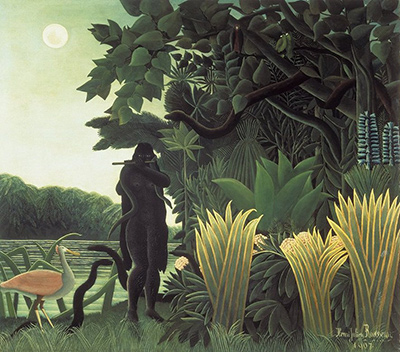
Henri Rousseau, the French artist known as "The Sleeping Gypsy," captivated the art world not through technical perfection but through an imaginative, nocturnal vision that defied academic norms. To create a work that echoes his unique signature style, one must move beyond mere mimicry and embrace a philosophy of spontaneity, bold color, and a distinct lack of rigorous perspective. This approach allows the artist to step into the shoes of the dreamer, transforming ordinary observations into fantastical, illuminated landscapes.
The Architecture of Illusion
At the heart of Rousseau's work lies a deliberate disregard for the rigid rules of linear perspective and anatomical correctness that dominated the French Academy of his time. His figures often appear flat, their limbs elongated or awkwardly joined, creating a sense of immediacy that feels both primitive and hyper-real. When attempting to replicate this look, the primary goal is to flatten the image. Do not strive to create deep three-dimensional space using traditional vanishing points; instead, layer colors directly onto the canvas to suggest atmosphere and light. The background should feel like a projection or a memory rather than a physically distant reality. By simplifying the structural logic of the scene, you invite the viewer's imagination to fill in the gaps, much like the way Rousseau allowed his jungles to stretch endlessly into the void.
Mastering the Palette of Night and Day
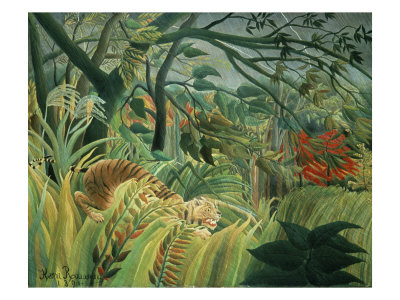
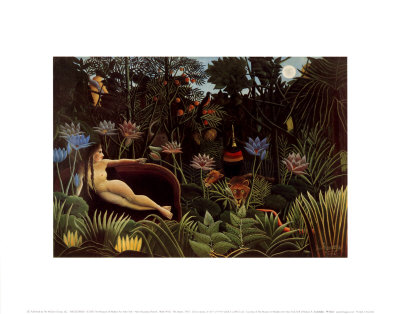
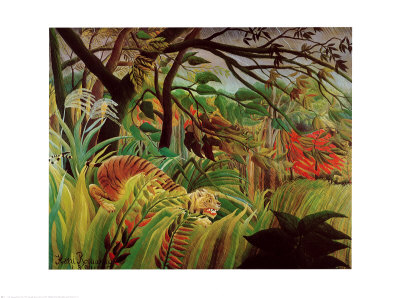
Rousseau is often associated with his nocturnal scenes, yet his color theory was surprisingly vibrant and modern for his era. He did not rely on the earthy, muted tones of the Impressionists; instead, he used rich, saturated blues, deep greens, and fiery oranges to create a dreamlike glow. To achieve this specific palette, focus on the contrast between the dark, velvety shadows of the foliage and the brilliant, almost neon highlights of the moonlight or the tropical flowers. The colors should vibrate against one another, creating a sensation of heat and humidity. Avoid mixing colors on the palette; keep the strokes distinct and separated, allowing the white of the canvas to peek through in certain areas to act as a highlighter, giving the illusion of luminosity without the need for actual light sources drawn on the surface.
Techniques for the Rough Stroke
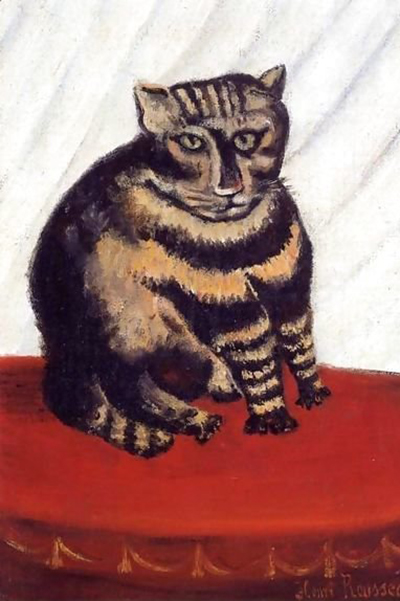
The brushwork is perhaps the most defining element of Rousseau's style, characterized by short, choppy, and sometimes clumsy strokes that appear at first glance to be mistakes but are actually intentional choices. This technique, often referred to as "naive" or "primitive," was a conscious decision by the artist to reject the smooth, blended surfaces of the academic tradition.
- Use short, staccato brushstrokes to build up texture in the leaves and grass.
- Do not blend colors seamlessly; leave visible edges where different hues meet.
- Apply paint thickly (impasto) to create a tactile surface that catches the eye.
- Avoid erasing the canvas; let the roughness of the application remain visible.
By adopting these specific techniques, the painting acquires a texture that feels alive and unrefined, mirroring the artist's own struggle to capture a dream rather than a photographed reality.
Composing the Jungle and The Garden
Whether the subject is a dense, mysterious jungle or a domestic garden, Rousseau's compositions are built on a foundation of asymmetry and hidden depth. His scenes often feature a "middle ground" that seems to break the plane of the picture, allowing trees to hang in mid-air or bushes to grow over the edges of the frame. To compose a similar piece, start by placing a large, dark mass of foliage in the center of the canvas, ensuring it dominates the space. Then, introduce human figures or animals in the foreground or background, often making them small and somewhat incongruous against the massive scale of nature. The key is to create a sense of mystery; do not explain every element of the scene. Leave the viewer to wonder where the path goes or how the light penetrates the thick canopy. This narrative ambiguity is essential to capturing the spirit of the "Sleeping Gypsy."
The Spirit of the Outsider
Finally, remember that the essence of Rousseau's style is not just in the visual tricks but in the emotional state of the artist. He was a man who painted from his imagination, unconstrained by the observations of the real world. When creating your own work, step away from your easel and look inward. Ask yourself what dream you are trying to manifest on the canvas. Is it a terrifying storm? A serene moonlit forest? A fantastical creature? Embrace the weirdness and the illogical. The most important rule is to trust your own internal vision rather than the external rules of art history. By prioritizing emotion and imagination over technical precision, you will begin to develop a personal voice that resonates with the timeless, hypnotic quality of Henri Rousseau's enduring legacy.
Related reading
- The Digital Brush: Reimagining the Dream World of Rousseau
- The Child in the Jungle: Cultivating the Spirit of Naïve Art
- Finding Your Own Wild Garden: A Guide to Choosing Subjects in Naïve Art
- The Artist's Canvas: Unveiling the Essentials of Naïve Creation
- Unlocking the Surreal Garden: A Guide to Finding Historical Naïve Art for Inspiration