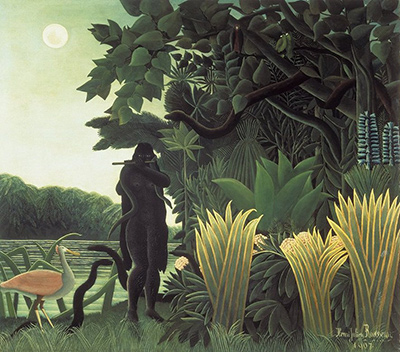
The term "naïve" often evokes images of innocent, untrained hands, yet the true masters of this genre possessed complex, deliberate methods. Henri Rousseau and Grant Wood, despite being grouped together, utilized vastly different techniques to achieve their unique visions. Understanding these divergent approaches reveals that their shared label was merely a historical categorization, masking two distinct artistic philosophies rooted in opposite worlds.
The Distinct Origins of Two Worlds
To understand the divergence in technique, one must first look at the backgrounds of the artists. Rousseau was a professional, educated artist who spent his life in a Parisian studio, surrounded by the city's vibrant café culture. He painted his famous jungles while asleep, a habit that allowed his mind to wander freely from reality. In contrast, Grant Wood was a regionalist who immersed himself deeply in the rural life of Iowa, absorbing the textures of cornfields and small-town architecture through direct observation and lived experience. Their starting points—urban isolation versus rural immersion—fundamentally shaped their visual languages before they ever picked up a brush.
The Architecture of the Naïve Mind
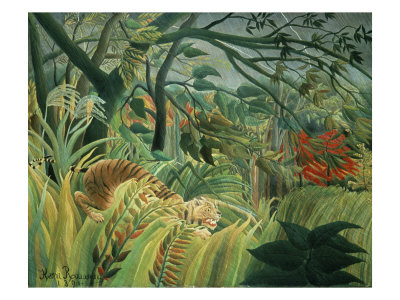
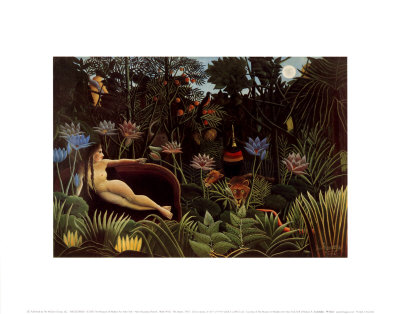
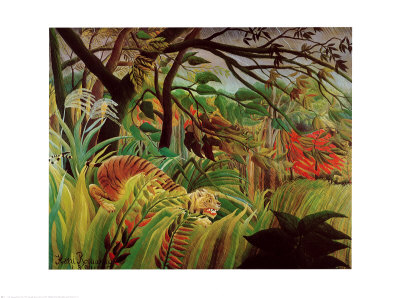
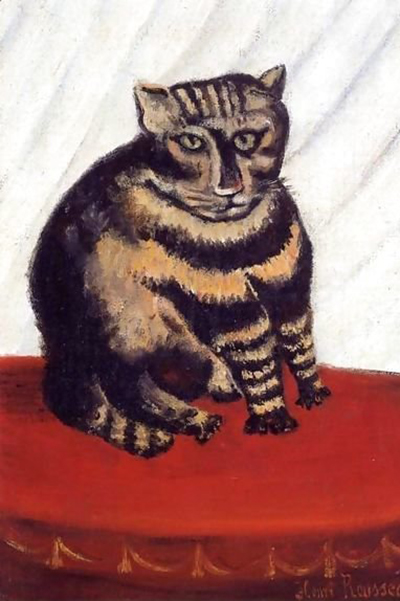
Both artists rejected the complex academic rules that dominated the art world in the early 20th century, yet they arrived at very different results. Rousseau's technique relied heavily on a sense of claustrophobia and impossible scale. He constructed his scenes as if looking through a peephole, compressing trees and animals into tight, overlapping planes that seem to press against the viewer. His brushwork, even when it appears loose, possesses a deliberate economy; he often used a limited palette of greens, browns, and blacks to create a monochromatic intensity that felt both primitive and highly sophisticated.
Grant Wood, conversely, sought to elevate the common scene to the status of high art through a mastery of light and texture. His technique was rooted in the American Impressionist tradition he admired, specifically the work of Childe Hassam. He did not simplify forms out of ignorance, but rather out of a desire to capture the specific quality of light hitting a barn or a silo. His figures, while stylized, retain a human dignity and anatomical correctness that distinguishes them from the often surreal proportions found in Rousseau's work.
The Role of Memory vs. Observation
A critical difference lies in how each artist gathered their subject matter. Rousseau famously claimed that his paintings were the result of "sleeping on" his ideas. He would sketch rough notes in his journal, and these fragments of memory would coalesce into fully realized scenes when he returned to his easel. This method meant his jungle scenes were never photographs of a real place; they were psychological constructs built from the collective imagination of the artist and his contemporaries.
Wood, however, was a man of action. He would walk the streets of Cedar Rapids, observing the way dust settled in the air or how the light changed during a corn harvest. He believed in the power of the immediate moment to inform the final piece. While he did not produce photorealistic studies, his commitment to capturing the specific atmosphere of his region gave his work a grounding reality that Rousseau's dreamscapes lacked.
The Palette of Nature and Urbanity
The color choices in each artist's work serve as another clear indicator of their different techniques and goals. Rousseau's color scheme is often described as murky and atmospheric. By limiting his palette, he creates a unified, almost hypnotic visual field where the distinctions between a snake, a tree, and a human figure blur together. The lack of bright, saturated highlights contributes to the feeling of being lost within a dense, unending wilderness.
Wood's palette, on the other hand, is defined by luminosity. He utilized the full spectrum of warm yellows, golds, and crisp blues to depict the American sun. His use of color was functional, meant to illuminate the subjects and make them appear solid and tangible. Where Rousseau used color to create mystery and depth through shadow, Wood used it to celebrate clarity and openness.
The Legacy of Naïve Innovation
Ultimately, the comparison between Rousseau and Wood highlights that "naïve" is not a lack of skill, but a specific choice of approach. Rousseau used his technique to explore the subconscious and the infinite, creating a visual language that felt alien yet compelling to modern audiences. Wood used his craft to assert the value of the ordinary and the American experience, creating a visual language that felt familiar and comforting.
Today, when we study these works, we see that the "naïve" label was a box that both artists eventually escaped. Rousseau proved that one could be a trained professional while painting like a child of dreams, and Wood showed that one could embrace regionalism with a technique that rivaled the masters of Paris. Their techniques diverge so sharply that they remind us that art history is not a single line, but a vast tapestry of different ways to see the world. Whether through the dark embrace of a jungle or the bright glare of a harvest, both artists offer unique windows into the human psyche, proving that simplicity in execution can mask incredible complexity in conception.
To summarize the key distinctions between these two giants of the genre:
- Rousseau prioritized psychological tension over realistic representation, relying on memory rather than sight.
- Wood focused on capturing the specific, luminous quality of the American rural landscape.
- Rousseau's brushwork is often loose and compressed, creating an enclosed space.
- Wood's brushwork is structured and detailed, aiming to mimic the texture of the physical world.
- The primary difference lies in the intent: Rousseau sought the mystery of the unknown, while Wood sought the dignity of the known.
Related reading
- The Digital Brush: Reimagining the Dream World of Rousseau
- The Child in the Jungle: Cultivating the Spirit of Naïve Art
- Finding Your Own Wild Garden: A Guide to Choosing Subjects in Naïve Art
- The Artist's Canvas: Unveiling the Essentials of Naïve Creation
- Unlocking the Surreal Garden: A Guide to Finding Historical Naïve Art for Inspiration