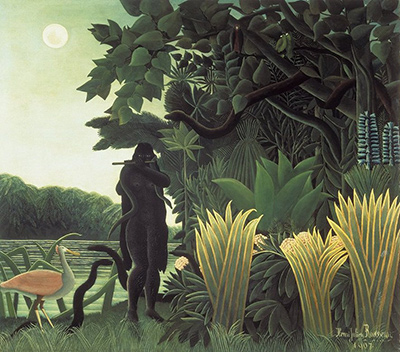
Henri Rousseau remains one of the most enigmatic figures in the history of art, a man who found his true voice not in the bustling streets of France, but in the imagined depths of an Amazonian rainforest. His career is a fascinating study in contrasts, where the vibrant, hyper-realistic depictions of the French capital coexist with dreamlike, primitive explorations of the jungle. To understand the full scope of his genius, one must examine how these two distinct realms interact within his body of work, revealing a mind that was simultaneously anchored in reality and lost in fantasy.
The Gritty Realism of Montmartre
Before Rousseau ever painted the monstrous flora of the Congo, he was deeply embedded in the artistic circles of Paris, specifically within the bohemian enclave of Montmartre. His early Parisian subjects are characterized by a meticulous, almost photographic attention to detail. In works depicting his neighbors, the streets of the Latin Quarter, or the lively cafes of Montmartre, Rousseau employed a technique that felt startlingly modern for his time. He captured the motion of a bustling crowd or the intricate architecture of a Parisian building with a precision that bordered on the mundane.
These paintings often feature a palette of muted, earthy tones, reflecting the actual light of the Parisian day. The figures in his city scenes are rendered with a solidity that suggests they are drawn from life, wearing their clothes with a logic that feels entirely terrestrial. Unlike his later work, where the human element often recedes into the background to let the exotic nature take center stage, the people in his Parisian pieces are the protagonists. They are engaged in specific, recognizable activities—selling flowers, drinking wine, or walking home—grounding the viewer in a tangible, everyday reality. This initial phase establishes Rousseau as a painter of the contemporary world, a skill he would later juxtapose against the impossible landscapes of his imagination.
The Birth of the Imaginary Amazon
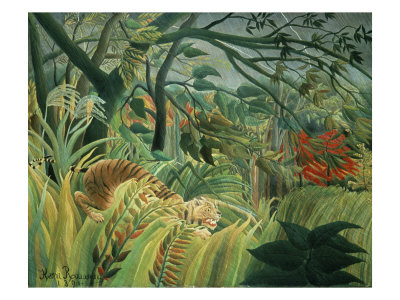
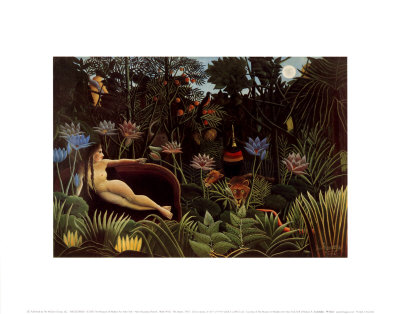
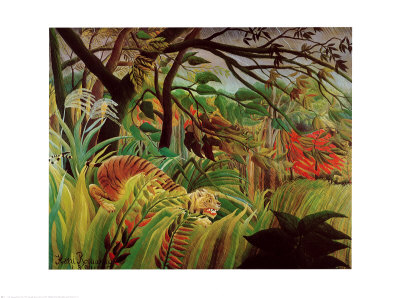
The transformation occurred when Rousseau, in his later years, retreated to the countryside near his home in Moret-sur-Loing. There, amidst the quiet isolation, his vision shifted dramatically. He began to construct elaborate, composite worlds that had no basis in reality. The "Jungle Fantasies" are not records of travel, nor are they direct observations of the rainforest; they are visual hallucinations brought to life by a solitary artist. In these canvases, the scale is often distorted. Giant ferns loom over tiny, insignificant human figures, creating a sense of vertigo and wonder.
A specific sub-theme within these fantasies is the confrontation between the civilized world and the primal forces of nature. This dynamic is best observed when looking closely at the interactions between the human characters and the surrounding vegetation.
The Dynamics of the Human Element in the Jungle
In the jungle scenes, the function of the human figure changes completely compared to his city portraits. The people are no longer the subjects of the study; they have become small notes in a symphony of green and gold. They appear often to be in states of confusion, fear, or awe. A man might be holding a gun that points into nothingness, or a woman might be gazing up at a towering vine. This psychological tension is the core of Rousseau's jungle narratives. The humans are not exploring; they are being overwhelmed by the sheer magnitude of the imaginary forest.
- The Absence of Geography: There is no horizon line that suggests where the jungle ends and the sky begins. The foliage often fills the entire frame, creating a claustrophobic yet expansive feeling.
- The Lighting Shift: The light in the jungle scenes is often unnatural, sometimes glowing with an ethereal quality that suggests a different time of day or a magical realism not found in nature.
- The Composition: The composition frequently employs a diagonal movement, guiding the eye from a central figure up into the dense canopy, emphasizing the height and density of the imagined trees.
A Unified Vision of Perception
Despite the vast differences in subject matter, the underlying approach to painting remains consistent. Rousseau's hand never truly let go of his established techniques; he simply applied them to new, impossible subjects. The brushwork in both his city and jungle works is bold, with thick impasto that gives his paintings a textured, tangible quality. He did not rely on the polished, smooth finish of the French Academy; instead, he embraced a style that felt immediate and raw.
The comparison between the two types of work highlights the duality of the artist himself. In Paris, he was a chronicler of the mundane, finding beauty in the ordinary. In his jungle fantasies, he became a dreamer, projecting his inner world onto the canvas. The juxtaposition is crucial because it shows that his talent was not limited to one genre. He possessed a versatility that allowed him to handle the detailed, narrative-driven scenes of the city with the same confidence as the abstract, symbolic representations of the forest.
The Legacy of Duality
Ultimately, the value of Rousseau's work lies in this duality. We do not need to choose between the Parisian realism and the jungle fantasy; rather, we must see them as two sides of the same coin. The detailed, grounded observations of his early career provide the foundation upon which his later, more abstract visions were built. The very familiarity of the Parisian streets makes the strangeness of the jungle even more potent. By presenting these contrasting worlds, Rousseau invited the viewer to question the boundaries of reality. He showed that while the world outside might be solid and defined, the world inside the mind of an artist could be anything at all, bounded only by the limits of the canvas and the imagination.
Related reading
- The Digital Brush: Reimagining the Dream World of Rousseau
- The Child in the Jungle: Cultivating the Spirit of Naïve Art
- Finding Your Own Wild Garden: A Guide to Choosing Subjects in Naïve Art
- The Artist's Canvas: Unveiling the Essentials of Naïve Creation
- Unlocking the Surreal Garden: A Guide to Finding Historical Naïve Art for Inspiration