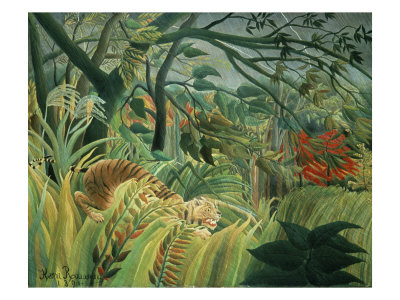
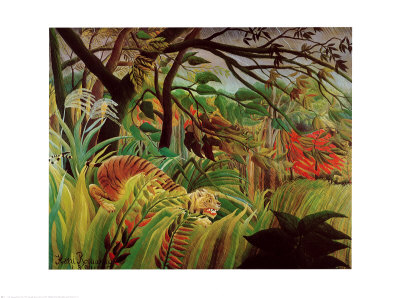
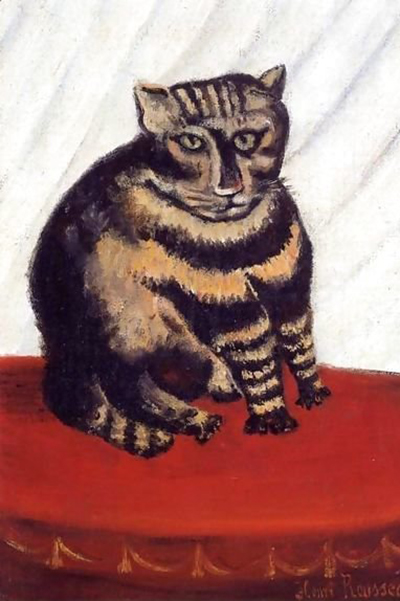
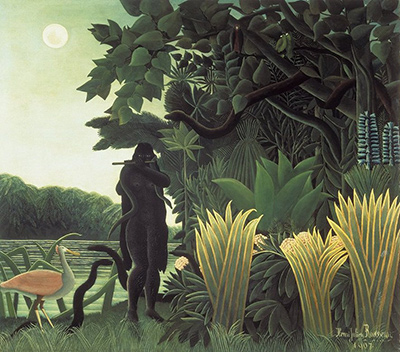
When attempting to capture the essence of Henri Rousseau's exotic jungle scenes, the most common pitfall for modern artists is attempting to impose strict linear perspective onto compositions that thrive on flat, two-dimensional spaces. Rousseau did not hide behind a window; he painted directly onto canvas, embracing the limitations of the medium to create a dreamlike, impossible reality where birds fly over elephant ears and lions sleep in the clouds. By over-correcting with realistic depth cues, you risk turning a vibrant hallucination into a technical exercise that lacks the magical, static quality that defines the Naive Art movement.
The Illusion of Three Dimensions
The human eye is naturally trained to interpret shadows, overlapping shapes, and converging lines as indicators of depth. In academic painting, these elements work in harmony to create a window into a world that exists in three dimensions. However, in the realm of Naive art, particularly in the style of the French painter Henri Rousseau, these conventions are often deliberately subverted. When an artist tries to force a flat arrangement into a deep, realistic space, the result is often a composition that feels crowded and disjointed, losing the distinct, isolated quality of the original work.
The Role of Unreal Depth
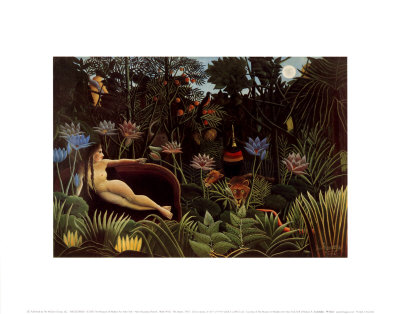
To understand why perspective fails here, one must recognize that Rousseau's work is not a record of reality but a representation of a mind's eye. In his famous painting "The Dream," the sky and the ground coexist in the same plane, defying gravity and spatial logic. This is not a mistake; it is the point. When you introduce a vanishing point, you are telling the viewer's brain to look for a horizon line and judge distances accordingly. This forces the eye to navigate a complex, three-dimensional path, whereas the viewer of a Rousseau painting should feel like they are floating in a static, dream state. The magic lies in the lack of a clear path to the background.
Breaking the Horizon Line
One of the most effective ways to maintain the flat aesthetic is to disrupt the horizon line entirely. In traditional perspective, the horizon line acts as a fixed plane separating the sky from the earth. In Naive art, this line becomes fluid, curving, or absent altogether. Artists should consider how elements from the top of the canvas can interact directly with elements from the bottom, creating a sense of compression rather than recession.
If you are struggling with your composition, try these adjustments to flatten the space:
- Align disparate objects horizontally so that a bird in the air and a flower on the ground share the same visual plane.
- Remove or distort shadows that clearly indicate a light source coming from a specific direction, as this instantly creates a sense of volume and depth.
- Overlap figures without creating a clear scale gradient, ensuring that large and small objects sit side-by-side without the small ones appearing distant.
The Power of Flat Color
Color is another tool that can be manipulated to prevent the creation of false depth. In realistic painting, color value (lightness and darkness) is primarily used to model form and suggest distance. In the style of Rousseau, color is used for emotional expression and pattern recognition. A bright, saturated blue might be placed next to a deep, dark green, but the difference in value should not necessarily indicate that one object is behind the other. By using a consistent value scale across the entire canvas, you reinforce the two-dimensional quality of the image. This prevents the eye from "falling" into the painting, keeping it locked onto the surface.
Embracing the Impossible Composition
Ultimately, the goal is to create a world that feels impossible, much like the surreal landscapes found in the works of Salvador Dalí, yet grounded in the simplicity of folk traditions. When you step back from your canvas, do not ask if it looks like a real place; ask if it feels like a dream. The most successful naive artworks are those where the viewer accepts the logic of the painting, even if it contradicts the laws of physics. If your composition feels too cluttered or too deep, try painting it larger or using more vibrant, contrasting colors to flatten the visual field. Remember that the beauty of this style lies in its refusal to mimic reality perfectly; it invites the viewer into a unique, personal universe where the rules of space are flexible and the imagination is the true architect.