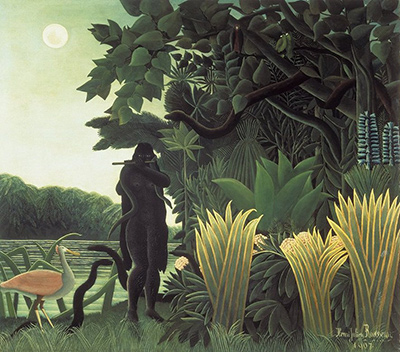
The persistent belief that naive paintings like those of Henri Rousseau require a ruler to validate their perspective is a fundamental misunderstanding of the art form that obscures its true power. This article explores why applying geometric precision to these works is not only unnecessary but actively destructive to their emotional and intuitive core. By examining the specific nature of naïve composition, we can learn to appreciate the deliberate choices that define this unique artistic language.
The Mathematical Fallacy of the Straight Edge
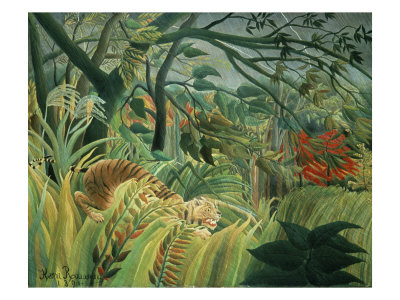
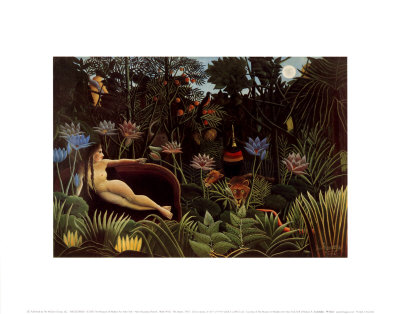
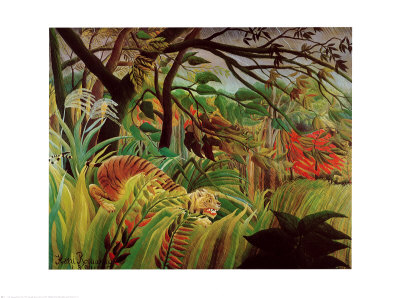
To understand why measuring a naive landscape with a ruler is a critical error, one must first understand the source of the confusion. For decades, art education emphasized one-point and two-point perspective, teaching artists to use geometric tools to ensure that parallel lines converge correctly at a specific vanishing point on the horizon. When an observer looks at a naive painting, such as Rousseau's jungle scenes, they may instinctively reach for a measuring device to find the center of the composition or to check if the trees are leaning at the correct angle. However, this approach assumes that the visual experience of the artist is merely a flawed attempt at realism, which is a false premise. Naïve artists do not paint what they see in a purely geometric sense; they paint what they see emotionally and intuitively. The "mistakes" are actually choices, and forcing a rigid grid onto them denies the very essence of the medium.
The Power of Intuition Over Geometry
Henri Rousseau famously stated that he had never taken a formal art class and had never learned how to paint from a book. Instead, he relied entirely on his immediate perceptions and his imagination. In his landscapes, the perspective is not calculated based on the position of the viewer relative to the scene; rather, it is dictated by the rhythm of the brushstrokes and the emotional weight of the subject matter. A tree might lean sharply to the left not because the horizon line is off, but because the artist wants to convey a sense of wind or instability. If you were to use a ruler to correct this tilt, you would be stripping the painting of its intended mood and replacing a dynamic, living scene with a static, mathematically perfect image. The beauty of naive art lies in its departure from the strict laws of physics and optics, inviting the viewer to engage with the artist's inner world rather than an external, objective reality.
Understanding the Naïve Perspective
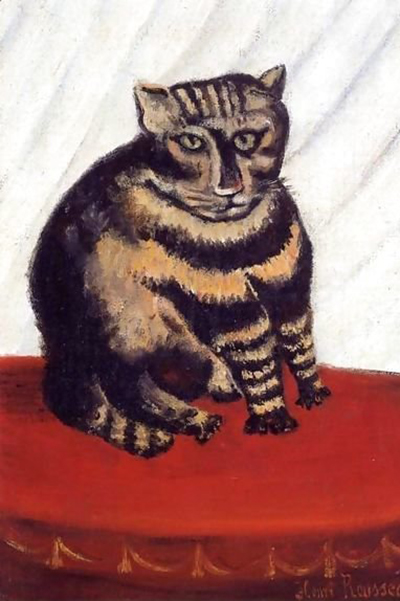
It is crucial to distinguish between the technical concept of perspective, which is a tool for creating three-dimensional space on a two-dimensional surface, and the artistic concept of perspective, which is a way of organizing the composition to create a specific feeling. In naive landscapes, the spatial relationships are often fluid and subjective. The artist might place a mountain in the foreground that appears larger than the sun in the background, or they might cluster trees in the middle ground without regard for depth cues like overlapping or size scaling. These deviations are not errors; they are the signature of the style. When an observer tries to measure these elements with a ruler, they are essentially asking the artist to apologize for their own vision. The ruler is an instrument of analysis used to critique a work against a standard, but in naive art, the standard is the artist's own unique perception. Therefore, the only way to truly appreciate the work is to suspend judgment and look for the internal logic of the composition, not the external logic of Euclidean geometry.
The Difference Between Technique and Expression
The confusion often arises from a misunderstanding of what constitutes a "mistake" in art. In academic painting, a deviation from perspective rules is a technical failure that can be easily identified and corrected with a straight edge. In naive art, however, the "imperfection" is the method of expression. Rousseau's jungle is not a scientifically accurate map of a forest; it is a dreamlike environment constructed from his memory and his imagination. The lines are jagged, the spaces are uneven, and the proportions are often exaggerated. These features create a sense of immediacy and authenticity that a perfectly rendered perspective cannot achieve. A landscape that adheres strictly to the rules of perspective can feel distant, cold, and mechanical. By contrast, a naive landscape feels warm, alive, and deeply personal. Attempting to measure the perspective is akin to trying to measure the temperature of a feeling; it is an absurd exercise that misses the point entirely. The value of the work is found in its inability to be measured by standard metrics.
Final Thoughts on Appreciating Naïve Art
Ultimately, the decision to use a ruler on a naive landscape is a decision to prioritize the intellect over the heart, and the standard over the individual. While understanding the basics of perspective can be helpful for those learning to paint, it should never be used as a metric to judge the quality or validity of a naive work. When viewing Henri Rousseau or similar artists, one should look for the narrative, the emotion, and the unique visual language that the artist has created. The lines that seem crooked are deliberate strokes of genius; the spaces that seem empty or crowded are intentional compositions. By stepping away from the ruler and engaging directly with the brushstrokes and the overall feeling of the piece, we can truly appreciate the profound beauty and the unique vision that defines this extraordinary chapter in art history.
To fully grasp this philosophy, consider the following indicators that distinguish naive perspective from academic perspective:
- The horizon line often does not align with the viewer's eye level but serves a compositional or symbolic purpose.
- Objects in the background may be painted larger than those in the foreground to emphasize their narrative importance.
- Vertical lines are frequently tilted regardless of the tilt of the ground plane to suggest movement or instability.
- The perspective vanishing point is either absent or serves the emotional needs of the scene rather than optical accuracy.
- Overlapping shapes may not follow strict size scaling rules, instead relying on color and texture to establish depth.
- The scale of figures and animals is determined by their proximity to the viewer's emotional experience rather than their physical distance.
- The composition prioritizes the rhythm of the brushstroke over the logical arrangement of geometric forms.
Recognizing these patterns allows the viewer to see the deliberate genius within the apparent chaos, transforming the act of observation from a search for errors into a celebration of human creativity.