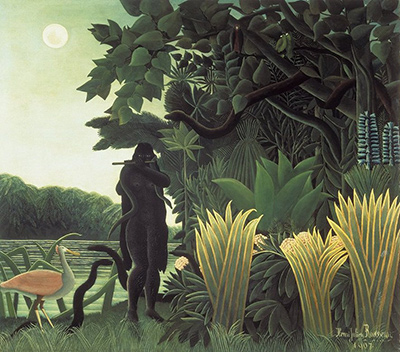
Many aspiring artists believe that to truly capture the spirit of Henri Rousseau, they must replicate his brushstrokes with mathematical precision, aiming for a flawless, hyper-realistic finish that mimics the master's technique. However, the essence of his unique style lies not in technical perfection, but in the deliberate, dreamlike looseness of his hand, which invites the viewer into a world where logic takes a backseat to imagination. Copying him is less about creating a photographic duplicate and more about embracing the freedom to leave things slightly unfinished, allowing the eye to wander over a landscape that exists only in the mind.
Embrace the Unfinished Look
When approaching a naïve style, the most common pitfall is the relentless pursuit of detail that crushes the atmosphere. Rousseau did not struggle with perspective or anatomical correctness in the traditional academic sense; instead, he constructed scenes that felt like memories rather than observations. If your copy looks too polished, too "finished," you have likely missed the point entirely. The magic of his work comes from the suggestion of form rather than the definition of it. Think of it as painting a story where the narrator stops midway to let the reader imagine the ending. Do not fill every gap with color or line; instead, let the canvas breathe. The viewer should feel they are looking through a window onto a secret garden, not a museum exhibit of a perfect painting. This requires a shift in mindset from "how do I make this look real?" to "how do I make this look like a dream?"
Simplify Your Forms and Structures
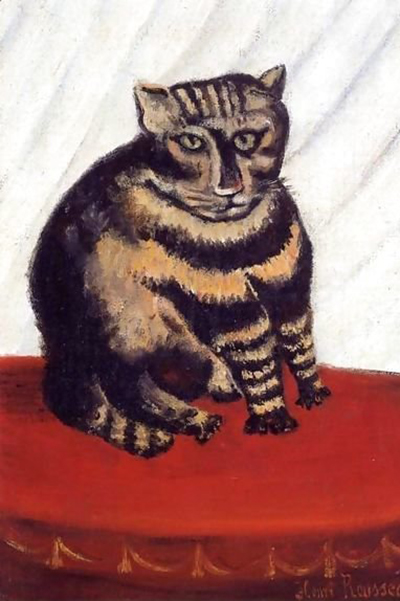
A frequent error when trying to replicate naïve art is attempting to preserve every complex structure found in nature, such as the intricate veins on a leaf or the complex branching of a tree. In Rousseau's paintings, nature is flattened and simplified into shapes that carry symbolic weight rather than biological accuracy. Instead of drawing every line, focus on the overall silhouette and the emotional impact of the form. A tree might become a series of bold, sweeping strokes that suggest height without needing to show every branch. This reductionism is key to achieving the style's distinctive charm. When in doubt, step back and ask if every single element you have drawn is necessary to convey the mood. Often, removing detail is the most effective way to enhance the composition.
The Power of Unconventional Perspective
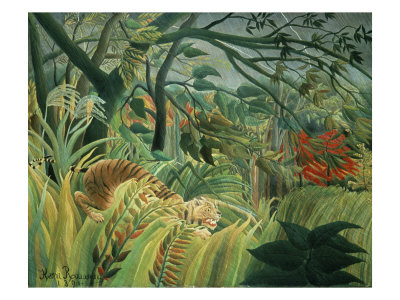
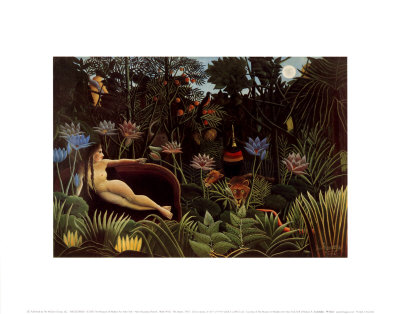
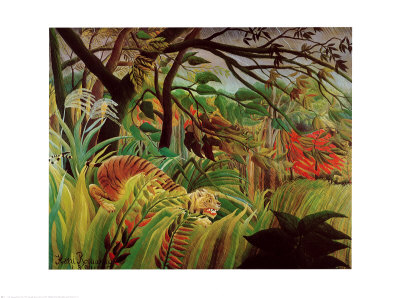
One of the most defining characteristics of the naïve style is the use of perspective that defies the rules of the Renaissance. In many of Rousseau's works, the floor appears to float, the horizon line is placed high in the sky to emphasize the vastness of the trees, and the background is often painted with a bright, glowing quality that makes it feel closer to the foreground. Beginners often try to force a realistic vanishing point, which instantly grounds the work in reality and kills the dreamlike quality. To avoid this mistake, experiment with placing objects at various depths without strict logical spacing. You can paint a bird flying very high above the ground with the same intensity as a flower in the immediate foreground. This spatial freedom allows the composition to feel more like a collage of thoughts than a study of the physical world. It is about organizing the scene based on narrative importance rather than visual distance.
Prioritize Color and Light Over Detail
Finally, many artists make the mistake of spending too much time on the outlines and textures while neglecting the overall color palette. In Rousseau's work, the colors are vibrant, flat, and often applied in blocks of unblended pigment. He avoided the subtle blending techniques that create a softer, more realistic transition. To achieve this style, use bold, distinct colors for each area of the painting. Do not fear leaving edges sharp or distinct. The light in his scenes often seems to emanate from within the objects themselves, creating a glowing effect that requires a simplified understanding of shadow. Focus on the harmony between your chosen colors rather than the fidelity of the lighting. A painting can be technically imperfect but emotionally perfect if the colors sing together and evoke the right feeling. Remember, the goal is to capture the feeling of the scene, not the image of the scene. By avoiding the trap of over-detailing and instead focusing on the freedom of the brush and the power of color, you will create a piece that honors the spirit of the naïve tradition.
A Practical Checklist for the Naïve Artist
To ensure you are staying true to the spirit of the movement rather than slipping into academic mimicry, consider these five critical adjustments during your workflow:
- Resist the urge to blend colors: Keep pigment distinct and separate; do not worry about smooth gradients.
- Ignore strict anatomical rules: It is better to capture the spirit of a subject than its exact biological proportions.
- Experiment with flat planes: Use large areas of solid color rather than trying to render depth through shading.
- Leave gaps in the composition: Do not cover every inch of the canvas; negative space is vital.
- Question the need for detail: If you can remove a line or a mark without losing the overall meaning, do so immediately.