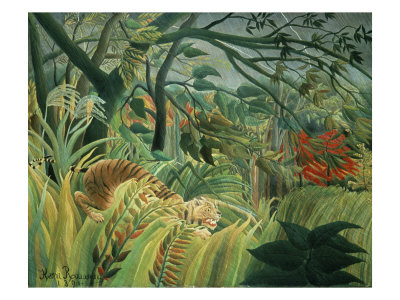
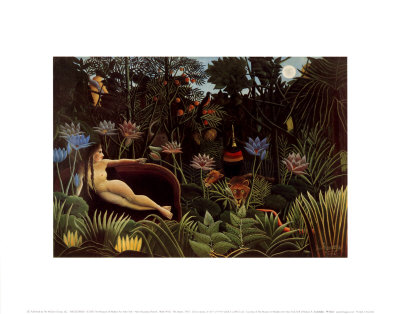
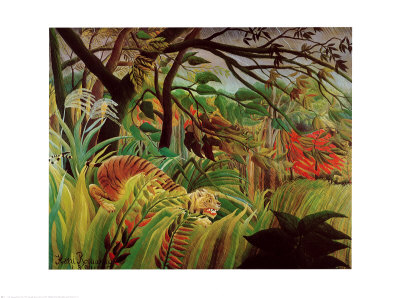
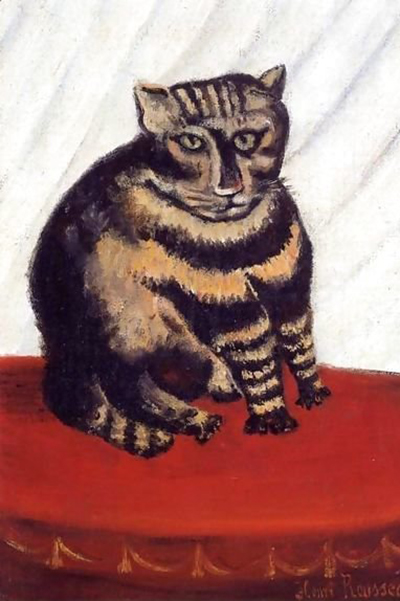
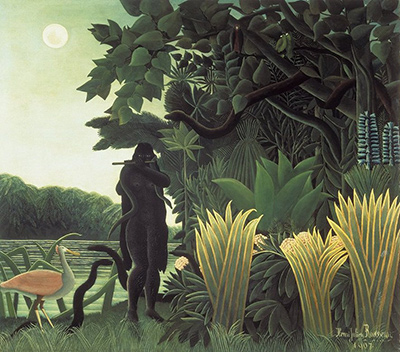
Many aspiring artists strive to replicate the vibrant energy of Henri Rousseau's jungle scenes, yet they frequently stumble when attempting to render the light within those compositions. Instead of observing the scene directly, they begin to overanalyze the physics of illumination, introducing shadows and gradients that completely contradict the flat, luminous quality of the original work. This overthinking often results in paintings that feel flat or artificially constructed rather than spontaneously created, missing the very essence of the naïve aesthetic where light acts as a form of color rather than a physical phenomenon. Understanding this distinction is crucial for anyone wishing to capture the dreamlike clarity found in Rousseau's masterpieces.
The Trap of Photorealistic Logic
The primary error occurs when the artist tries to apply the rules of Western academic painting to a subject that was never intended for realism. In traditional art, light is a tool used to create volume, depth, and three-dimensionality. It involves calculating highlights, mid-tones, and cast shadows to give objects a solid presence in space. However, in the world of naïve art, particularly in the style of Rousseau, objects do not exist in a realistic physical space. The jungle is a memory, a fantasy, or a mental projection, not a documented reality. Therefore, the artist must resist the urge to model their subjects with realistic shading.
When an artist tries to make a bird's wing look like a physical flap of fabric by adding a sharp shadow underneath, they are imposing logic on a dream. The light in a naïve scene should not be a physical force that casts shadows; it is a visual element that defines the surface. By thinking too much about how light interacts with form, the artist kills the spontaneity. The result is often a painting that looks like a photograph with a filter, lacking the brushy texture and directness that defines the genre.
Embracing the Flat Plane of Light
To correct this mistake, one must adopt a mindset where light is synonymous with color. In many of Rousseau's works, the "light" is simply a specific hue applied to the surface of the object. If the sun is setting, it does not mean the bottom of a tree should be dark; it means the bottom of the tree should be a warm, glowing orange or yellow that matches the intensity of the sky. This approach flattens the image, which is exactly what the artist intends to achieve.
The goal is to create a two-dimensional surface where everything shares the same luminous plane. Shadows are not created by the absence of light but by a different color tone that sits alongside the brights. When you stop asking "where does the shadow fall?" and start asking "what color is the shadow in this mood?", the painting begins to breathe with the correct naïve energy. The artist becomes a colorist rather than a light engineer.
The Role of the Brushstroke in Illumination
Since the artist is no longer trying to sculpt light with shading, the brushstroke becomes the primary vehicle for the appearance of light. In academic painting, the brushstroke might hide to create smooth transitions. In naïve art, the brushstroke reveals itself to create the texture of the light itself. The dabs of paint should feel energetic and immediate, suggesting the quick glance of an artist who has seen something magical and wants to record it instantly.
The rhythm of the strokes can mimic the quality of the light. Sharp, angular strokes might suggest a harsh, direct sunlight, while broader, swirly marks can imply a misty, diffused atmosphere. The key is to let the texture of the paint surface contribute to the overall brightness. A thick application of paint in the "light" areas, contrasted with thin, washed-out glazes in the "shadow" areas, can create a vibrating effect that feels alive. This technique ensures that the light feels tangible and present, not just a theoretical concept calculated by the artist's mind.
Avoiding the Shadow Trap in Composition
A common manifestation of overthinking lighting is the heavy use of black or dark blue shadows to ground the composition. While this works well in realistic landscapes, it often suffocates the vibrant colors of a naïve scene. In Rousseau's paintings, the background often recedes into a uniform wash of color rather than deep darkness. The horizon line is not a boundary between light and dark, but a line that separates two different moods of color.
When artists place deep shadows at the bottom of the page, they are trying to make the forest floor look like a real place where light cannot reach. In the naïve imagination, light reaches everywhere, or rather, the artist's mind fills in the gaps with color. If a bird is flying in the center of the canvas, the air around it should be as bright and clear as the bird itself. There should be no invisible barrier of darkness blocking the view. The artist must learn to let the colors of the background push forward, making the entire canvas feel like a window into a brightly lit world.
Practical Steps to Fix Your Lighting Issues
To move forward with your next painting and escape the trap of overthinking, consider implementing these specific adjustments in your workflow:
- Stop using a black or dark blue underlayer for shadows; instead, mix your shadows from the complementary color of the highlight (e.g., use orange-brown for a green subject's shadow).
- Apply paint thinly in areas you think are shadows and thickly in areas you think are highlights to enhance the flat, luminous effect.
- Ignore the concept of form completely until the end of the process; focus entirely on placing the right color in the right spot based on your memory of the scene.
- Review your work by holding it up to a window; if the shadows look like they are casting onto a real floor, you are thinking too much about reality.
- Simplify your palette to ensure that the variations in tone are achieved through color shifts rather than value shifts.
By following these guidelines, you will begin to see that the light in a naïve scene is not something to be studied with scientific precision, but a feeling to be painted with emotional honesty. The magic lies in the simplicity of the observation and the direct translation of that observation onto the canvas, free from the constraints of physical laws.