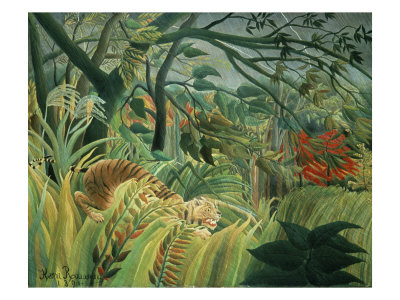
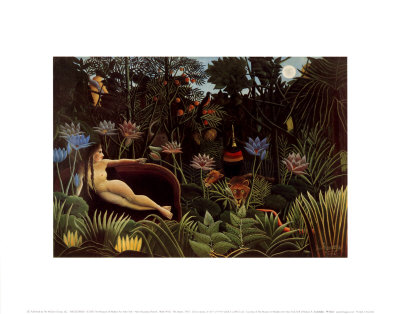
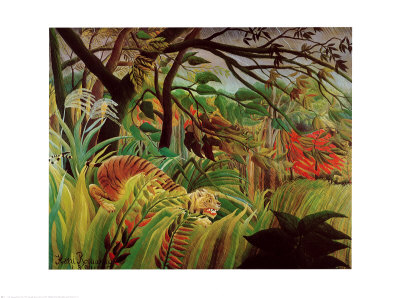
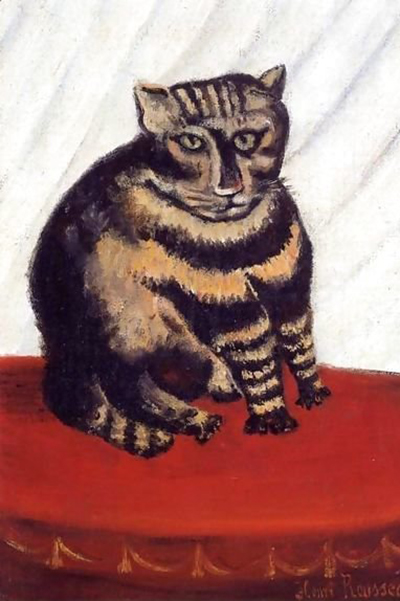
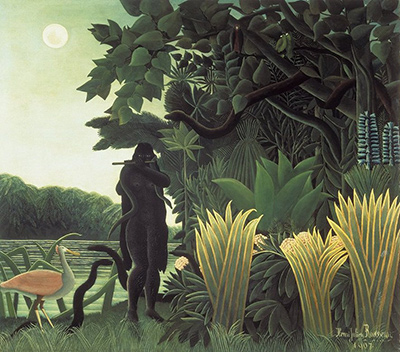
To truly understand the dreamy, naive aesthetic of Henri Rousseau, one must first step away from the rigorous rules of academic realism and step into the vibrant, chaotic, and utterly sincere mind of a man who painted jungles he never visited. His work is not merely an accurate depiction of the natural world; it is a window into a specific state of being where imagination reigns supreme over observation, creating scenes that feel both startlingly distant and intimately known. Reviewing your own art with this lens requires a shift in focus from technical perfection to emotional resonance, asking yourself whether your work breathes with the same quiet confidence and wild joy that defines the Master's legacy.
Embracing the Uncanny Beauty
The first step in cultivating this specific vibe is to intentionally embrace elements that would normally be corrected during a traditional critique. In Rousseau's paintings, perspective often shifts, vanishing points disappear, and the scale of objects varies wildly without a logical reason, yet these quirks do not feel like errors; they feel like intentional distortions that heighten the dreamlike quality. When reviewing your canvas, ask yourself if you have been too polite to the composition. Have you smoothed out every jagged edge? Have you forced every tree to grow in a straight, orderly line? To achieve the naive look, you must allow the composition to remain slightly awkward, letting the viewer feel a bit disoriented in a pleasant way, as if they are stumbling upon a secret garden known only to the artist.
The Art of Incoherent Geometry
This section is dedicated specifically to navigating the geometry of your work. Naive art often features a rejection of strict linear perspective in favor of a more intuitive, spatial arrangement that prioritizes the emotional impact of the scene over geometric accuracy. Look for areas in your painting where the horizon line might be ambiguous, or where foreground elements loom larger than background figures without a clear vanishing point. This lack of mathematical precision is not a flaw but a feature; it invites the viewer to project their own understanding of space onto the image, creating a participatory experience. If your lines are too clean and your angles too perfect, consider softening them. Introduce slight tilts, uneven horizons, and overlapping planes that defy standard rules of depth. The goal is to make the viewer feel like they are peeking through a curtain into a dream, rather than standing before a photograph.
Vibrant, Unpredictable Color Palettes
Color in the naive style is not chosen for realism but for its ability to evoke a specific mood and energy. Rousseau's work is characterized by flat areas of bold, saturated color that do not fade into shadows or highlights in a naturalistic gradient. When reviewing your color choices, consider if your palette feels too restrained or too muted. Ask yourself if you are using color to tell a story or to create an atmosphere. Introduce unexpected combinations of hues, such as bright oranges against deep blues, or stark whites that glow rather than reflect light. The colors should feel electric and present, as if they are shouting their presence to the viewer. Avoid using too many different shades of the same color in a single object, as this tends to ground the object in reality. Instead, use a limited number of distinct, high-contrast colors that stand out against one another, creating a sense of unity through visual weight rather than tonal harmony.
Simplification Through Aggressive Edging
One of the most telling characteristics of the naive aesthetic is the treatment of forms. Complex objects, such as a tree with hundreds of leaves or a bird with intricate feathers, are often rendered with simplified shapes, bold outlines, and a reduction of detail. When you look at your work, scan for areas of excessive clutter. Are you trying to capture every single leaf or feather, which often results in a muddy, realistic texture? Instead, try to define the essential shape of the object and surround it with a few representative details. The edges of objects should be distinct, often defined by a dark line that separates the form from the background, creating a graphic quality that resembles a print or a child's drawing. This simplification creates a sense of clarity that is actually a form of obscurity, where the details are so few that the viewer's brain fills in the gaps with its own imagination.
- Check if your main subjects have clear, defined outlines.
- Ensure you have reduced the number of tiny, distracting details.
- Verify that your background does not compete too heavily with the foreground.
- Confirm that your light sources appear consistent, even if they are not realistic.
- Ask yourself if the image feels like a memory rather than a document.
The Power of Static Composition
Finally, consider the movement within your painting. Rousseau's scenes are often frozen in time, capturing a single, perfect moment without the sense of action or motion. Even in scenes with animals or people, there is often a stillness that suggests a pause in the flow of time. Review your composition to see if there is a sense of dynamic energy that distracts from the dreamy quality. Do the figures appear to be in the middle of a dramatic leap or a complex interaction? Often, slowing down the action and presenting the scene in a more static, almost sculptural way enhances the naive feel. The viewer becomes a silent observer of a tableau that exists outside the normal rush of daily life. Ensure that the overall arrangement feels balanced yet slightly unsettled, creating a tension between the stability of the frame and the wildness of the contents within.
By rigorously applying these principles, you can move beyond simple imitation and begin to capture the unique spirit of the naive artist. It is a practice of letting go of the need to be correct and instead embracing the beauty of the imperfect, the strange, and the wonderfully dream-filled.